

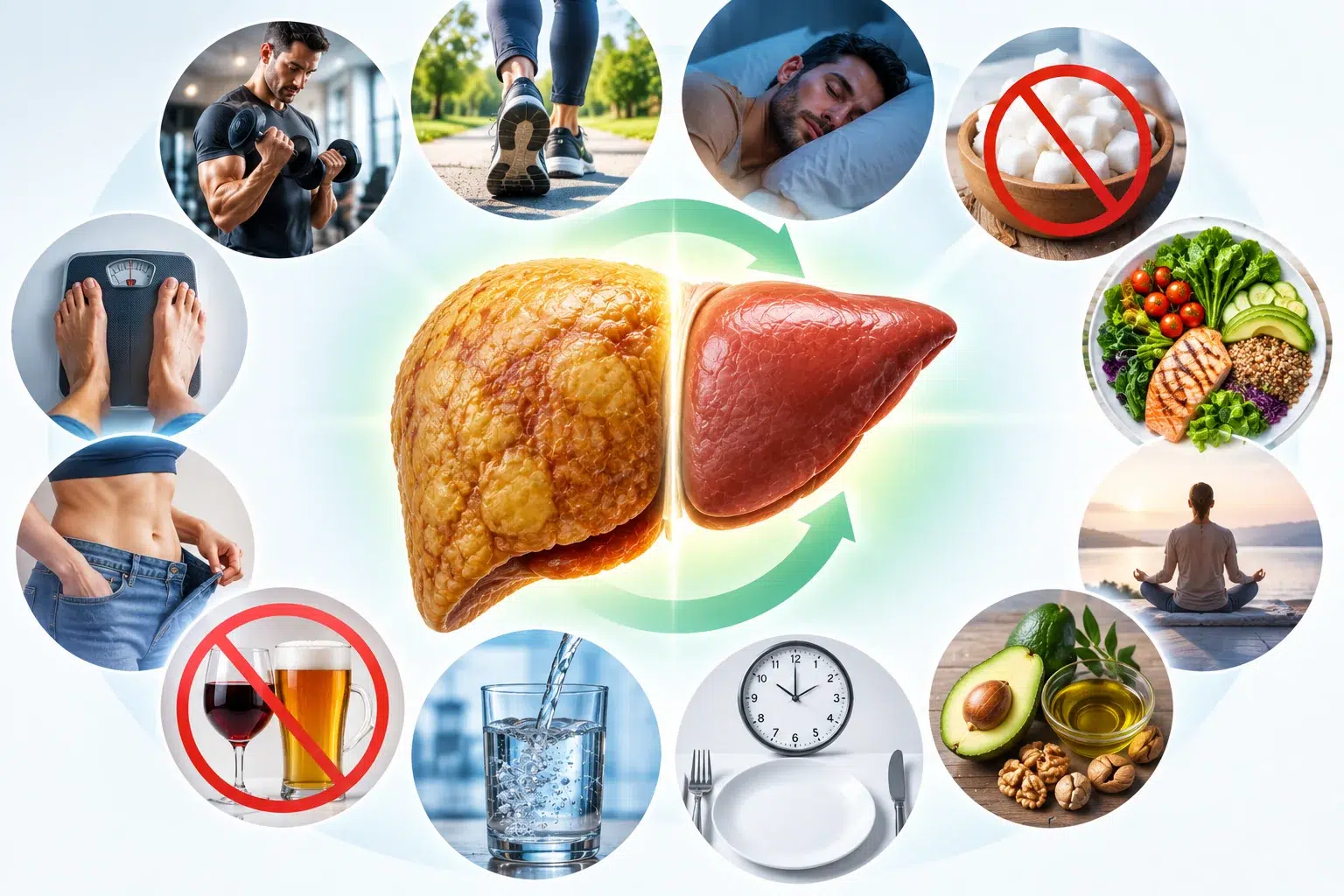
If you have been told you have fatty liver, the good news is that it can be reversed. These are the 10 gastroenterologist tips to reverse fatty liver I give in clinic, with what the evidence says about each one and how to apply it without an impossible diet.
Before the tips: the number that matters
The 2024 European guidelines sum up fatty liver treatment as lifestyle change: losing weight, changing diet, exercising and avoiding alcohol.1 And the weight you lose shapes the result. In a study of 293 people with biopsy-proven steatohepatitis, the more weight they lost, the more their liver improved:2
The last figure is the most honest one: losing weight is hard and keeping it off is harder. That is why the tips below are not a diet but habits you can sustain. And there is good news: exercise reduces liver fat even when the scales do not move.3
The 10 tips
1. Do strength training two or three times a week
A systematic review compared aerobic and resistance exercise in fatty liver: both reduce liver fat, but resistance training does it with less cardiorespiratory effort. The typical effective protocol was about 45 minutes, three times a week, for 12 weeks.4 In a randomized trial, three months of strength training reduced liver fat compared with stretching alone, and the improvement did not depend on how much weight was lost.5 Muscle also protects: in more than 330,000 UK Biobank participants, those with the most muscle mass had less than half the risk of developing severe fatty liver disease.6
How to apply it: squats, lunges, rows, presses and deadlifts, with bands, dumbbells or your own body weight. Increase the load gradually and eat enough protein at every meal so you do not lose muscle while losing weight, especially if you take drugs such as Ozempic or Mounjaro.
2. Walk every day, ideally after meals
A meta-analysis showed that exercise reduces liver fat even if you do not lose weight, and with activity levels even below the recommended amount.3 European guidelines advise at least 150 minutes a week of moderate activity.1 Timing matters too: breaking up sitting time with short, light walks lowers the rise in glucose after meals more than standing alone, and also lowers insulin.7
How to apply it: a 10-15 minute walk after lunch and dinner, and getting up to walk for a few minutes every half hour if you sit at work. If getting started is hard, see the benefits of exercise for the digestive system.
3. Sleep 7-8 hours: short sleep drives hunger
Two nights of four hours' sleep were enough to lower leptin (the satiety hormone) by 18%, raise ghrelin (the hunger hormone) by 28% and increase hunger by 24%, especially for calorie-dense, carbohydrate-rich foods.8 Sleep debt also raises evening cortisol and worsens glucose tolerance.9 In practice, short sleep makes people eat about 385 kcal more a day without burning more,10 and short sleepers have a slightly higher risk of fatty liver.11
How to apply it: keep a regular schedule, have a light dinner two or three hours before bed and keep screens out of the bedroom. If you snore and wake up tired, get checked: sleep apnea is common in people with fatty liver. More in sleep and gut health.
4. Zero free sugars
Free sugars are added sugar plus the sugar in honey, syrups and fruit juice. In a trial in adolescents with fatty liver, eight weeks of a low free sugar diet reduced liver fat from 25% to 17%, with almost no change on the usual diet.12 More than the glucose spike itself, what hurts the liver most is fructose: drinks sweetened with fructose or table sugar doubled fat production in the liver, while the same amount of glucose did not.13
How to apply it: cut out soft drinks, juice (including fresh juice), pastries, sugary cereals, biscuits and sugary sauces. Whole fruit is fine: it does not count as free sugar. If giving up soda is hard, switching to the sugar-free version as a bridge was linked to less liver fat in a meta-analysis of trials.14 The end goal is water.
5. 16:8 intermittent fasting, if it helps you eat less
Fasting for 16 hours with an 8-hour eating window works, but not by magic. In the TREATY-FLD trial, eating within an 8-hour window with calorie restriction reduced liver fat just as much as calorie restriction alone: 8.3% versus 8.1% at six months.15 In another trial, alternate-day fasting combined with exercise also reduced it compared with doing nothing.16 In other words, fasting is a tool to eat less, not a treatment in itself.
How to apply it: for example, finish dinner at 8 pm and do not eat again until noon, with water, coffee or unsweetened tea during the fast, and without bingeing afterwards. If you take insulin or other glucose-lowering diabetes drugs, talk to your doctor first.
6. Half a plate of vegetables, a quarter protein and a quarter whole grains
It is the simplest way to apply the Mediterranean diet, the one guidelines recommend, at every meal.1 In a trial in people with fatty liver, the Mediterranean diet reduced liver fat by 39%, compared with 7% on a low-fat diet, with the same weight loss.17 The plate controls portions without counting calories: vegetables fill you up and add fiber, protein keeps you full and protects muscle, and whole grains are absorbed more slowly than refined ones.
How to apply it: half a plate of raw or cooked vegetables; a quarter of fish, eggs, chicken, legumes or tofu; and a quarter of brown rice, wholemeal bread, whole-wheat pasta or potato. Dress it with extra virgin olive oil, and go back for more vegetables, not more carbs.
7. Eat real food: olive oil yes, ultra-processed food no
In a meta-analysis of more than 60,000 people, a high intake of ultra-processed food was linked to a 42% higher risk of fatty liver.18 It is an association, not proof of cause, but it points in the same direction as the trials of the Mediterranean diet, rich in olive oil, vegetables, legumes and fish.17
How to apply it: buy foods with few ingredients you recognize. Swap pastries for fruit and nuts, ready meals for home cooking, and sunflower oil or butter for extra virgin olive oil.
8. Alcohol: the less the better, ideally none
With fatty liver, even light drinking counts. In a study with repeat biopsies, people who drank up to two drinks a day improved their liver fat less and had about a third of the odds of resolving steatohepatitis compared with non-drinkers.19 In a follow-up of 8,345 people with fatty liver, drinking 10-19 grams of alcohol a day (one or two drinks) doubled the risk of advanced liver disease compared with lifetime abstainers.20 That is why guidelines discourage alcohol.1
How to apply it: if you drink every day, start by dropping weekdays, and do not replace alcohol with sugary drinks. I explain more in the effects of alcohol on the digestive system.
9. Coffee, yes: two or three cups, no sugar
Coffee does not remove liver fat, but a meta-analysis linked it to 35% lower odds of significant fibrosis, which is what really drives the outlook.21
How to apply it: black or with milk, without sugar or syrups, and not so much caffeine that it disturbs your sleep. More in is coffee a superfood?.
10. Know your fibrosis: ask for a FIB-4 and, if needed, a FibroScan
The fat itself is not the main worry: what decides the outlook is fibrosis, the scarring of the liver. The risk of dying from liver disease rises exponentially with each fibrosis stage.22 European guidelines propose two-step screening: first the FIB-4 score, calculated from a routine blood test, then elastography (FibroScan) if the result is not low.1 If there is moderate or advanced fibrosis, drugs now exist. Semaglutide resolved steatohepatitis in 62.9% of patients versus 34.3% on placebo,23 and resmetirom in 26-30% versus 9.7%.24
How to apply it: if you have fatty liver with type 2 diabetes, obesity or raised liver enzymes, ask for your FIB-4. In Europe, resmetirom has a conditional EMA authorization for steatohepatitis with moderate or advanced fibrosis; semaglutide is approved for this indication in the United States, while in Europe its indication remains obesity. If lifestyle changes are not enough to lose weight, there are more options: GLP-1 drugs, or endoscopic procedures such as the Apollo method.
Your plan at a glance
| Tip | How much | What it achieves |
|---|---|---|
| Strength training | 2-3 sessions a week | Less liver fat and more muscle |
| Walking | 150 min a week, and after meals | Less liver fat, even without weight loss |
| Sleep | 7-8 hours | Less hunger and less snacking |
| Zero free sugars | Always | Less fat production in the liver |
| 16:8 fasting | If it suits you | Eating less without counting calories |
| ½-¼-¼ plate | Every meal | Portion control and a Mediterranean diet |
| Real food | Every day | Fewer ultra-processed foods |
| Alcohol | As little as possible; ideally none | Better odds of reversing inflammation |
| Coffee | 2-3 cups, no sugar | Less fibrosis in observational studies |
| FIB-4 and FibroScan | At diagnosis | Knowing if there is fibrosis and if you need drugs |
Common myths
When to see a gastroenterologist
Get assessed if you have fatty liver and also:
- A FIB-4 that is not low or an abnormal elastography.
- Type 2 diabetes or obesity, which raise the risk of fibrosis.
- Raised liver enzymes that do not fall with lifestyle changes.
- Yellow skin or eyes, a swollen abdomen, vomiting blood or confusion: in that case, go to the emergency department.
How I approach it in clinic
First I measure where you stand: blood tests, FIB-4 and, if needed, elastography. That tells us whether lifestyle change is enough or whether there is fibrosis that justifies a drug. Then we pick two or three of these tips to start with, the ones that fit your life best, and add the rest gradually. More on the fatty liver page and in can fatty liver be cured?.
Been told you have fatty liver?
We assess your fibrosis and build a realistic plan. In Madrid or by video consultation.
Book an AppointmentRelated reading


In clinic, the first step is measuring fibrosis: it decides whether habits are enough or treatment is needed.
Frequently asked questions
Can fatty liver be cured?
Yes, in many cases. Liver fat can disappear and inflammation can reverse with lifestyle change. In a biopsy study, 90% of people who lost at least 10% of their weight resolved steatohepatitis and 45% improved fibrosis.
How long does it take for fatty liver to go away?
Liver fat starts to fall within weeks: in one trial, eight weeks without free sugars clearly reduced it. Inflammation and fibrosis need months, usually a year or more of sustained weight loss.
Is intermittent fasting good for fatty liver?
It works if it helps you eat less. In a randomized trial, 16:8 fasting with calorie restriction reduced liver fat as much as calorie restriction alone. If you take glucose-lowering diabetes drugs, check with your doctor first.
Which is better for fatty liver, walking or lifting weights?
Both work and they complement each other. Exercise reduces liver fat even without weight loss, and strength training does it with less cardiorespiratory effort while also protecting muscle.
Can I drink coffee and alcohol if I have fatty liver?
Coffee, yes: two or three cups without sugar are linked to less fibrosis. Alcohol, the less the better, because even light drinking is linked to a worse course of fatty liver.
References
- European Association for the Study of the Liver (EASL). EASL-EASD-EASO Clinical Practice Guidelines on the management of metabolic dysfunction-associated steatotic liver disease (MASLD). J Hepatol. 2024;81(3):492-542. PubMed (opens in a new tab)
- Vilar-Gomez E, et al. Weight Loss Through Lifestyle Modification Significantly Reduces Features of Nonalcoholic Steatohepatitis. Gastroenterology. 2015;149(2):367-78.e5; quiz e14-5. PubMed (opens in a new tab)
- Keating SE, et al. Exercise and non-alcoholic fatty liver disease: a systematic review and meta-analysis. J Hepatol. 2012;57(1):157-66. PubMed (opens in a new tab)
- Hashida R, et al. Aerobic vs. resistance exercise in non-alcoholic fatty liver disease: A systematic review. J Hepatol. 2017;66(1):142-152. PubMed (opens in a new tab)
- Zelber-Sagi S, et al. Effect of resistance training on non-alcoholic fatty-liver disease a randomized-clinical trial. World J Gastroenterol. 2014;20(15):4382-92. PubMed (opens in a new tab)
- Petermann-Rocha F, et al. Associations of muscle mass and grip strength with severe NAFLD: A prospective study of 333,295 UK Biobank participants. J Hepatol. 2022;76(5):1021-1029. PubMed (opens in a new tab)
- Buffey AJ, et al. The Acute Effects of Interrupting Prolonged Sitting Time in Adults with Standing and Light-Intensity Walking on Biomarkers of Cardiometabolic Health in Adults: A Systematic Review and Meta-analysis. Sports Med. 2022;52(8):1765-1787. PubMed (opens in a new tab)
- Spiegel K, et al. Brief communication: Sleep curtailment in healthy young men is associated with decreased leptin levels, elevated ghrelin levels, and increased hunger and appetite. Ann Intern Med. 2004;141(11):846-50. PubMed (opens in a new tab)
- Spiegel K, et al. Impact of sleep debt on metabolic and endocrine function. Lancet. 1999;354(9188):1435-9. PubMed (opens in a new tab)
- Al Khatib HK, et al. The effects of partial sleep deprivation on energy balance: a systematic review and meta-analysis. Eur J Clin Nutr. 2017;71(5):614-624. PubMed (opens in a new tab)
- Wijarnpreecha K, et al. Short sleep duration and risk of nonalcoholic fatty liver disease: A systematic review and meta-analysis. J Gastroenterol Hepatol. 2016;31(11):1802-1807. PubMed (opens in a new tab)
- Schwimmer JB, et al. Effect of a Low Free Sugar Diet vs Usual Diet on Nonalcoholic Fatty Liver Disease in Adolescent Boys: A Randomized Clinical Trial. JAMA. 2019;321(3):256-265. PubMed (opens in a new tab)
- Geidl-Flueck B, et al. Fructose- and sucrose- but not glucose-sweetened beverages promote hepatic de novo lipogenesis: A randomized controlled trial. J Hepatol. 2021;75(1):46-54. PubMed (opens in a new tab)
- McGlynn ND, et al. Association of Low- and No-Calorie Sweetened Beverages as a Replacement for Sugar-Sweetened Beverages With Body Weight and Cardiometabolic Risk: A Systematic Review and Meta-analysis. JAMA Netw Open. 2022;5(3):e222092. PubMed (opens in a new tab)
- Wei X, et al. Effects of Time-Restricted Eating on Nonalcoholic Fatty Liver Disease: The TREATY-FLD Randomized Clinical Trial. JAMA Netw Open. 2023;6(3):e233513. PubMed (opens in a new tab)
- Ezpeleta M, et al. Effect of alternate day fasting combined with aerobic exercise on non-alcoholic fatty liver disease: A randomized controlled trial. Cell Metab. 2023;35(1):56-70.e3. PubMed (opens in a new tab)
- Ryan MC, et al. The Mediterranean diet improves hepatic steatosis and insulin sensitivity in individuals with non-alcoholic fatty liver disease. J Hepatol. 2013;59(1):138-43. PubMed (opens in a new tab)
- Henney AE, et al. Ultra-Processed Food Intake Is Associated with Non-Alcoholic Fatty Liver Disease in Adults: A Systematic Review and Meta-Analysis. Nutrients. 2023;15(10). PubMed (opens in a new tab)
- Ajmera V, et al. Among Patients With Nonalcoholic Fatty Liver Disease, Modest Alcohol Use Is Associated With Less Improvement in Histologic Steatosis and Steatohepatitis. Clin Gastroenterol Hepatol. 2018;16(9):1511-1520.e5. PubMed (opens in a new tab)
- Åberg F, et al. Risks of Light and Moderate Alcohol Use in Fatty Liver Disease: Follow-Up of Population Cohorts. Hepatology. 2020;71(3):835-848. PubMed (opens in a new tab)
- Ebadi M, et al. Effect of Coffee Consumption on Non-Alcoholic Fatty Liver Disease Incidence, Prevalence and Risk of Significant Liver Fibrosis: Systematic Review with Meta-Analysis of Observational Studies. Nutrients. 2021;13(9). PubMed (opens in a new tab)
- Dulai PS, et al. Increased risk of mortality by fibrosis stage in nonalcoholic fatty liver disease: Systematic review and meta-analysis. Hepatology. 2017;65(5):1557-1565. PubMed (opens in a new tab)
- Sanyal AJ, et al. Phase 3 Trial of Semaglutide in Metabolic Dysfunction-Associated Steatohepatitis. N Engl J Med. 2025;392(21):2089-2099. PubMed (opens in a new tab)
- Harrison SA, et al. A Phase 3, Randomized, Controlled Trial of Resmetirom in NASH with Liver Fibrosis. N Engl J Med. 2024;390(6):497-509. PubMed (opens in a new tab)
- Halegoua-DeMarzio D, et al. Challenges in herbal-induced liver injury identification and prevention. Liver Int. 2025;45(3):e16071. PubMed (opens in a new tab)