
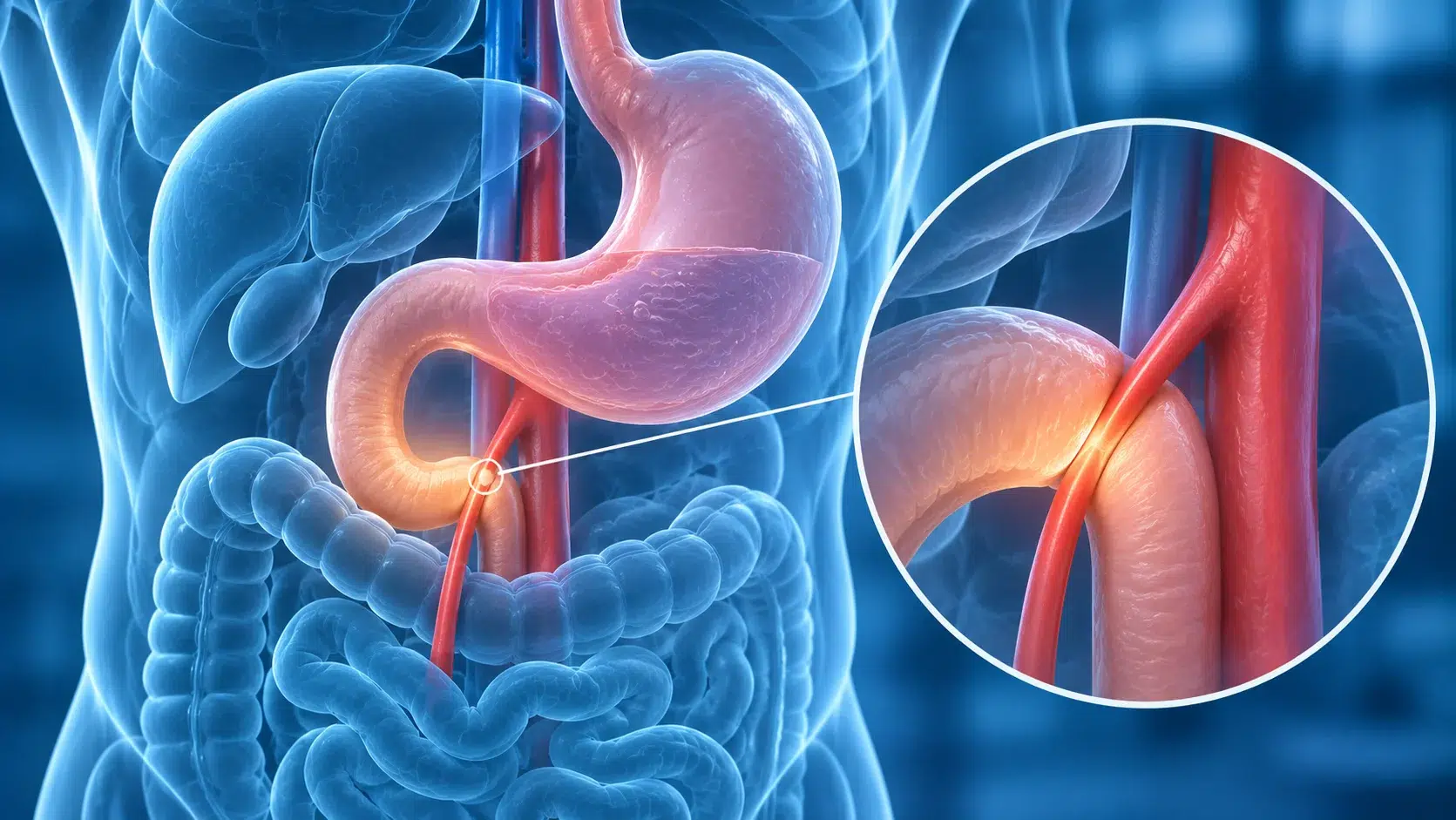
Superior mesenteric artery syndrome is compression of the duodenum between the aorta and the superior mesenteric artery, and it almost always appears after heavy weight loss. It is uncommon, and I increasingly see it mentioned in CT reports of people who do not have it. When it is genuine, it causes vomiting and weight loss and needs treatment, almost always starting with nutrition.
What superior mesenteric artery syndrome is
The duodenum is the first stretch of the small intestine, the part that follows the stomach. Its third part crosses the abdomen from right to left between two arteries: the aorta lies behind it and the superior mesenteric artery in front, branching off the aorta at an angle. A cushion of fat between the two keeps that angle open. When the fat disappears, the angle closes, the artery presses the duodenum against the aorta and food struggles to get through.12 It is also called Wilkie syndrome.
It is rare. In a 2023 review, the median age was 23 years, with cases ranging from newborns to 91-year-olds, and it affected women slightly more than men, in a ratio of 3 to 2.1 In a hospital in India, researchers went through 2,100 records of patients with abdominal pain and only 7 had the syndrome confirmed on CT, 0.3%.5
Who is most at risk
There is almost always rapid weight loss behind it, or an illness that wastes the body, what doctors call a catabolic state.2 These are the typical situations:
- Anorexia nervosa and other eating disorders. The symptoms of the syndrome are easily mistaken for those of anorexia itself.1 In a 2025 systematic review of 189 malnourished patients, mental health problems, especially eating disorders, were common.7
- Bariatric surgery. A 2026 review gathered 20 cases after obesity surgery, all in women and most after gastric bypass.8
- Scoliosis surgery. Correcting the spine changes the anatomy of the area.2 In a review of 61 adolescents operated on for idiopathic scoliosis, the mean age was 15.8 years and the mean body mass index 16.5. Symptoms appeared on average 69 days after surgery, but the range was 3 days to 4 years.9
- Other abdominal operations, such as proctocolectomy with an ileoanal pouch, and casts or braces that compress the trunk, hence its old name of cast syndrome.12
- Cancer, major burns, long stays in intensive care or any illness that causes heavy weight loss in a short time.2
A vicious circle sets in. The person loses weight, the angle closes, they eat less because food disagrees with them, and they lose even more weight.3
I am often asked whether the new weight loss drugs, such as semaglutide or tirzepatide, can cause it. I have not found any published cases on PubMed. These drugs cause nausea and vomiting on their own, as I explain in this article on Ozempic, Wegovy and Mounjaro, so if someone vomits while taking them, the first thing I review is the drug and the dose. If weight loss is very fast and the vomiting does not settle once the dose is adjusted, the syndrome goes on the list, as it would with any sudden weight loss.
Symptoms: when to suspect it
These are the symptoms of a stomach that cannot empty because something is blocking the way further down: pain in the upper abdomen after eating, nausea, vomiting, feeling full very quickly, loss of appetite and weight loss.12 Because the compression lies below the point where bile enters the duodenum, the vomit may be green or contain food eaten hours before.
Many patients find out for themselves that lying face down, on their left side or on their knees with the chest resting forward brings relief. In those positions the bowel falls forward and the angle opens a little, which is why position changes are part of the initial treatment.1
The difficulty is that the symptoms closely resemble those of functional dyspepsia and of anorexia nervosa,1 and most people with pain after meals and nausea do not have this syndrome. If nausea is what bothers you most, I go through the usual causes in constant nausea: causes and treatment, and if you are unsure where the pain comes from, the guide to abdominal pain by location can help you get your bearings.
When vomiting goes on for days, the problem is no longer only digestive. The body loses acid and salts, metabolic alkalosis develops, and vomit can be inhaled into the lungs and cause aspiration pneumonia.1 If I suspect this syndrome in someone who vomits every day, I do not leave it for an appointment a month later.
How it is diagnosed
The usual test is a contrast CT scan, which measures the angle between the aorta and the superior mesenteric artery and the distance between them where the duodenum passes. MR angiography and ultrasound are radiation-free alternatives, and ultrasound shows in real time how the artery moves and whether contents get through.13 A barium study, an older test, shows the narrowing of the duodenum, delayed emptying of the stomach and how the obstruction changes with position.3
What the images need to show is an obstruction: the stomach and duodenum dilated up to the point where the artery crosses, and a narrow duodenum just beneath it.34 In four patients with the syndrome studied with CT, the mean angle was 13.5 degrees and the distance 4.4 mm, while the normal ranges usually quoted are 28 to 65 degrees and 10 to 34 mm.4 In the Indian series, the 7 patients had a median of 22 degrees and 6 mm, against about 52 degrees and 11 mm in people with abdominal pain from other causes.5
The false positive problem
A narrow angle on a CT scan is not a disease. In Iraq, researchers measured the angle and distance in 333 people who had a CT scan for reasons unrelated to the digestive system. The angle ranged from 10 to 147 degrees and the distance from 4 to 44 mm, and very low values turned up in people with no symptoms and no compression of the duodenum. The figures were lower in women, in underweight people and in those under 20,6 which is exactly the profile of the people who tend to come in worried about it.
That is why the diagnosis has to bring symptoms and imaging together.3 Patients come to clinic with a report that says "reduced aortomesenteric angle", convinced they have the syndrome, when what they have is functional dyspepsia or centrally mediated abdominal pain. Without vomiting, a dilated stomach or weight loss, a measurement in a report does not justify an operation.
I almost always request a gastroscopy as well. It rules out an ulcer, a tumor or a narrowing of the pylorus that could explain the vomiting, and in this syndrome it may show a dilated stomach and duodenum with food residue. I cover when a gastroscopy is recommended and how to read the report in other articles.
What it can be confused with
Nutcracker syndrome
The same clamp between the aorta and the superior mesenteric artery can trap a different structure, the left renal vein. That is nutcracker syndrome, and its symptoms are different, mainly flank pain and blood in the urine. Compression of the vein without symptoms is a common imaging finding, and an international expert consensus could not agree on cut-off values to diagnose it.15 The two syndromes can occur together: in a Spanish series of 13 patients operated on for superior mesenteric artery syndrome, 4 also had a narrowed left renal vein.13
Median arcuate ligament syndrome
Here the compressed vessel is the celiac trunk, the artery that supplies the stomach, liver and pancreas, squeezed by a fibrous band of the diaphragm. It also causes pain after meals and weight loss. Ever since it was first described, people have questioned whether it exists as a disease. A 2022 systematic review found symptom relief in more than 70% of patients in most studies, but almost all of them had a high or unclear risk of bias.16 In the Spanish series, 4 of the 13 patients also had severe stenosis of the celiac trunk, which was treated in the same operation.13
Gastroparesis and other motility disorders
In gastroparesis the stomach empties slowly with nothing blocking it, and the symptoms are almost the same. Telling them apart matters because operating on the clamp does not fix gastroparesis. In a series of 18 operated patients, 14 improved at first, but at the latest follow-up only 6 were still well; several were later diagnosed with gastroparesis or a global motility disorder.12 In another series of 25 patients followed for a median of 5.3 years, 7 (28%) needed further major operations for motility disorders, and 4 of them died during follow-up.11 Other gastric motility disorders have to be ruled out before surgery.13
Functional dyspepsia and centrally mediated abdominal pain are far more common than any of these syndromes. They cause pain, nausea and early fullness without any obstruction, and they are treated by working on the gut-brain axis, not with surgery.
Treatment: regain weight first
The aim is to restore the fat that separates the artery from the aorta. Initial treatment is conservative: position changes, emptying the stomach through a tube if it is very dilated, and nutrition. According to a 2023 review, it works in 70-80% of cases.1 If the patient cannot eat by mouth, they are fed through a tube that reaches the jejunum, beyond the clamp, or intravenously (parenteral nutrition).2
Patients do not need to regain much. In the systematic review of 189 malnourished patients, gaining an average of 5.64 kg, about 12% of body weight, was associated with conservative treatment working without surgery. In those with a psychiatric disorder, especially an eating disorder, psychological treatment improved outcomes.7 Day to day, that means eating small amounts often, starting with puréed or liquid textures, and staying for a while in the position that brings relief after meals.
After bariatric surgery the proportions are reversed: only 15% improved without an operation, 85% needed surgery, most often a duodenojejunostomy, and symptoms resolved in 95%.8
When to operate and which operation
If conservative treatment fails, the procedure of choice is laparoscopic duodenojejunostomy. The dilated duodenum, above the clamp, is joined to a loop of jejunum, so food bypasses the compression. The 2023 review gives it a success rate of 80-100%.1
When all the series are pooled, the result is somewhat more modest. A 2023 systematic review of 168 operated patients found that surgery failed in 21%, with a mortality of 0.4%, and that 5% needed further procedures for persistent symptoms.10 In the Spanish series of 13 patients, with a median follow-up of 94 months, 8 (61.5%) had an excellent result.13
The alternative is the Strong procedure: the duodenum is mobilized and the ligament of Treitz that holds it is divided, so it drops down out of the clamp without joining it to another loop of bowel.2 A variant, duodenal derotation, relieved symptoms in 18 of 19 patients (95%) in a series spanning 33 years, with 2 major long-term complications.14
What most determines the result is choosing well who gets operated on.1013 If someone has regained weight and still feels just as bad, I ask myself again whether the diagnosis is right before sending them to a surgeon.
Outlook
When the diagnosis is correct, the outlook is good. Most patients improve once they regain weight,17 and those who need surgery usually do well.18 In the laparoscopic duodenojejunostomy series followed for a median of 5.3 years, body mass index rose from 19.2 to 21.6, and pain, nausea and weight loss all decreased.11 The worst results are concentrated in patients who also had a motility disorder.1112
If the cause was anorexia nervosa, the outlook depends mainly on treating it. With renewed weight loss, the angle can close again.
Myth or fact? Test what you know
Pick an answer for each statement and see what the evidence says.
1. “A small aortomesenteric angle on CT is enough to diagnose the syndrome.”
Myth. In 333 people without digestive problems the angle ranged from 10 to 147 degrees, with very low values and no compression of the duodenum. The diagnosis requires obstructive symptoms and imaging that match.36
2. “It usually appears after losing weight quickly.”
Fact. The most common cause is rapid weight loss or an illness that wastes the body, which removes the fat between the aorta and the artery.2
3. “Most patients end up having surgery.”
Myth. Conservative treatment, with nutrition and position changes, works in 70-80% of cases. The exception is the syndrome after bariatric surgery, where 85% needed an operation.18
4. “Regaining a few kilos can be enough for the symptoms to go away.”
Fact. Gaining an average of 5.64 kg, about 12% of body weight, was associated with recovery without surgery.7
5. “Lying face down or on your left side can relieve the symptoms.”
Fact. In those positions the angle opens a little, and position changes are part of the initial treatment.1
0 of 6 answered
Summary: what the evidence says at each step
| Aspect | What we know | What it means | Strength |
|---|---|---|---|
| Small angle and distance on CT | Also found in people without symptoms, especially young, thin women | On their own they diagnose nothing | Little value in isolation |
| Obstructive symptoms with a dilated stomach and duodenum | The basis of the diagnosis | Symptoms and imaging must agree | Reviews and case series |
| Position, nutrition and regaining weight | Improvement in 70-80%; about 5-6 kg is enough | Always the first step | Reviews of published cases |
| Laparoscopic duodenojejunostomy | 80-100% success in one review; 21% failure in another | Procedure of choice if the above fails | Series, variable results |
| Strong procedure and derotation | 18 of 19 patients relieved in one series | Alternative without joining loops of bowel | A single series |
| Surgery with associated gastroparesis or dysmotility | Worse results and more reoperations | Rule them out before operating | Small series |
Green clinical trial or guideline · Amber studies with mixed results · Red association or weak evidence
When to see a doctor soon
Get medical advice without waiting if you have any of these symptoms:
Tick any you have:
If you have also lost a lot of weight because of anorexia, an operation or a serious illness, do not wait to see whether it passes.
How I approach it in clinic

“A small angle on a CT scan is not a diagnosis. If there is no vomiting and no dilated stomach, I look for another cause before talking about surgery.”
Dr. Pedro de María Pallarés
When someone brings me a CT scan with a low aortomesenteric angle, I look at the person first: whether they vomit, whether they have lost weight, whether they tolerate food and whether the stomach is dilated on the scan. If there is no obstruction, I look for another explanation and treat that. If there is, I start with nutrition and position, together with the nutrition team and, when needed, psychiatry or psychology. I only consider surgery when that fails and I have ruled out gastroparesis.
Have you been told you may have this syndrome, or do you vomit after eating?
We go through your tests and symptoms and decide on the next step together. In Madrid or by video consultation.
Book an AppointmentDid you find this useful?
If someone you know has been told they may have superior mesenteric artery syndrome, this may help:
WhatsApp XRelated reading



Most cases of superior mesenteric artery syndrome improve without an operation.
Frequently asked questions
What is superior mesenteric artery syndrome?
It is compression of the third part of the duodenum between the aorta and the superior mesenteric artery, which happens when the fat that separates the two arteries disappears, almost always after rapid weight loss. It is also called Wilkie syndrome.
What symptoms does it cause?
Pain in the upper abdomen after eating, nausea, vomiting that may be green or contain food from hours before, early fullness, loss of appetite and weight loss. Many patients feel better lying face down or on their left side.
Is a CT scan showing a small angle enough to diagnose it?
No. Very low angles and distances are found in people without symptoms whose duodenum is not compressed. The diagnosis needs obstructive symptoms and imaging that shows the stomach and duodenum dilated up to the artery.
Can it be cured without surgery?
In most cases, yes. With nutrition, sometimes through a tube, and position changes, 70-80% of patients improve, and regaining about 5-6 kg is usually enough. If that fails, the procedure of choice is laparoscopic duodenojejunostomy.
How is it different from nutcracker syndrome?
Both happen between the aorta and the superior mesenteric artery. In superior mesenteric artery syndrome the duodenum is compressed and the symptoms are digestive; in nutcracker syndrome the left renal vein is compressed, mainly causing flank pain and blood in the urine. The two can occur together.
References (16 studies · tap to view)
- Oka A, et al. Superior mesenteric artery syndrome: Diagnosis and management. World J Clin Cases. 2023;11(15):3369-3384. PubMed (opens in a new tab)
- Welsch T, et al. Recalling superior mesenteric artery syndrome. Dig Surg. 2007;24(3):149-56. PubMed (opens in a new tab)
- Warncke ES, et al. Superior mesenteric artery syndrome: a radiographic review. Abdom Radiol (NY). 2019;44(9):3188-3194. PubMed (opens in a new tab)
- Agrawal GA, et al. Multidetector row CT of superior mesenteric artery syndrome. J Clin Gastroenterol. 2007;41(1):62-5. PubMed (opens in a new tab)
- Alzerwi NAN. Predictors of Superior Mesenteric Artery Syndrome: Evidence from a Case-Control Study. Cureus. 2020;12(8):e9715. PubMed (opens in a new tab)
- Hadi SS, et al. Normal values of angle and distance between the superior mesenteric artery and aorta in Iraqi population: A single centre study. J Med Radiat Sci. 2022;69(2):191-197. PubMed (opens in a new tab)
- Gibson D, et al. Predictors of Successful Weight Restoration in the Treatment of Superior Mesenteric Artery Syndrome: A Systematic Review. Nutrients. 2025;17(18). PubMed (opens in a new tab)
- Mitchell S, et al. Superior Mesenteric Artery Syndrome Following Bariatric Surgery: A Systematic Review. Obes Surg. 2026;36(4):1955-1964. PubMed (opens in a new tab)
- Pappalardo G, et al. Superior mesenteric artery syndrome following spine surgery in idiopathic adolescent scoliosis: a systematic review. Eur J Med Res. 2024;29(1):410. PubMed (opens in a new tab)
- Jonas JP, et al. Surgical therapy of celiac axis and superior mesenteric artery syndrome. Langenbecks Arch Surg. 2023;408(1):59. PubMed (opens in a new tab)
- Wills MV, et al. Long-term outcomes of laparoscopic duodenojejunostomy for superior mesenteric artery syndrome. Surg Endosc. 2025;39(8):5235-5243. PubMed (opens in a new tab)
- Chang J, et al. Laparoscopic duodenojejunostomy for superior mesenteric artery syndrome: intermediate follow-up results and a review of the literature. Surg Endosc. 2017;31(3):1180-1185. PubMed (opens in a new tab)
- Cienfuegos JA, et al. Minimally Invasive Surgical Approach for the Treatment of Superior Mesenteric Artery Syndrome: Long-Term Outcomes. World J Surg. 2020;44(6):1798-1806. PubMed (opens in a new tab)
- Ha CD, et al. Duodenal derotation as an effective treatment of superior mesenteric artery syndrome: a thirty-three year experience. Am Surg. 2008;74(7):644-53. PubMed (opens in a new tab)
- Heilijgers F, et al. Nutcracker syndrome (a Delphi consensus). J Vasc Surg Venous Lymphat Disord. 2025;13(1):101970. PubMed (opens in a new tab)
- Metz FM, et al. Systematic Review of the Efficacy of Treatment for Median Arcuate Ligament Syndrome. Eur J Vasc Endovasc Surg. 2022;64(6):720-732. PubMed (opens in a new tab)