
Published 3 October 2026
Why Do I Get Diarrhea From Alcohol?
Next-day diarrhea is very common, but it is not always harmless. Here is why it happens, what makes it worse and when it is a sign of something more.

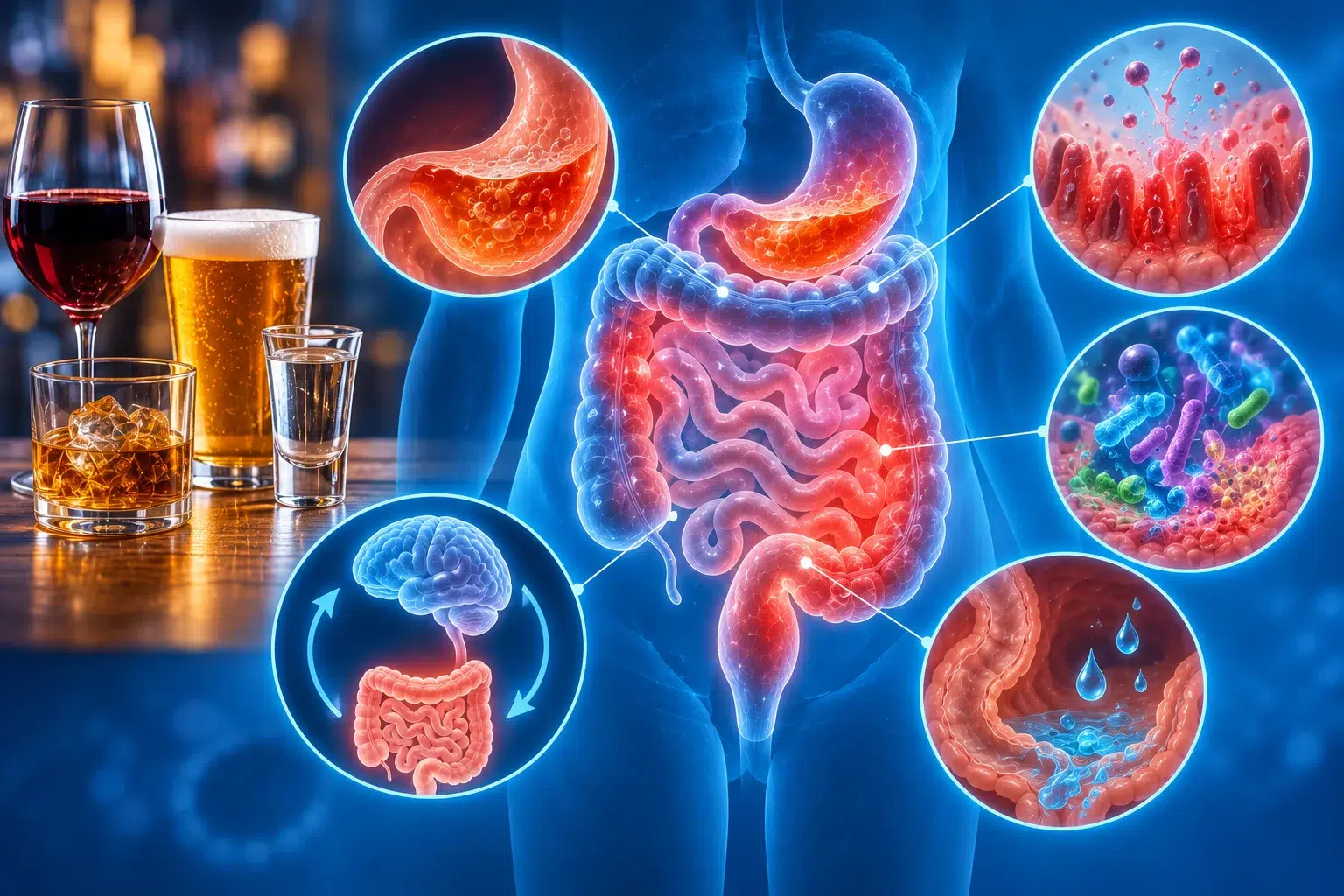
Alcohol acts on the gut in several ways at once: the lining, the bacteria, the pancreas and the way we drink.
The short version
Occasional diarrhea, after a night out
- Common and almost always benign.
- Mainly caused by drinking a lot in a short time.
- Worse if you have irritable bowel syndrome.
Regular diarrhea, if you drink often
- The gut absorbs water and salt less well.
- Bacterial overgrowth and microscopic colitis become more likely.
- The pancreas may stop digesting fat properly.
When to worry? If it lasts more than a few days, wakes you at night, or comes with blood, fever or weight loss. See the red flags.
Before you read on
This article is general information, not a diagnosis. If your drinking worries you, your family doctor can help in complete confidence.
Getting diarrhea from alcohol is something almost everyone has experienced and almost nobody mentions in clinic. Most of the time it is a passing effect of a heavy night. But when it happens with little alcohol, keeps coming back or does not go away, it is worth understanding what is happening in the gut, because it may be a clue to something else.
Why alcohol causes diarrhea
There is no single mechanism but several that add up. It helps to separate them, because they do not weigh the same after one night as with regular drinking.1
- Irritation of the lining. A single episode of heavy drinking can cause erosions in the duodenum and injury to the upper small bowel.1
- Poorer absorption of water and salt. The gut fails to recover part of the fluid it receives, and that fluid ends up in the stool. As you will see, this is mainly an effect of sustained drinking.2
- A leakier gut barrier. In heavy drinkers, the lining lets through more molecules than it should.6
- Changes in gut bacteria. Alcohol alters the microbiota and is associated with small intestinal bacterial overgrowth.57
- What comes with the drinking. Large, fatty meals, sugary mixers, gas, caffeine and little sleep. All of these speed up the gut too.
Next-day diarrhea: what the evidence says
Here is a surprising fact. When it was measured directly in healthy volunteers, putting alcohol into the small bowel on a single occasion did not change water and sodium absorption.2 Nor did it impair nutrient absorption.3 In other words, one night's alcohol does not "flush" the gut on its own.
So why do so many people get diarrhea the next day? Mainly because of the amount and how sensitive your gut is. The best study on this followed women with and without irritable bowel syndrome for a month using daily diaries. In those with irritable bowel syndrome, having four or more drinks in a day was clearly linked to diarrhea, nausea, stomach pain and indigestion the next day. Light or moderate drinking was barely associated with symptoms. And in women without irritable bowel syndrome, no drinking pattern was linked to symptoms.4
The practical conclusion: if next-day diarrhea happens to you often, the problem is probably not just the alcohol but a particularly sensitive gut. It is very typical of diarrhea-predominant irritable bowel syndrome, which I discuss in how I treat continuous diarrhea and gas and on the page on irritable bowel syndrome.
If you drink often: when diarrhea becomes regular
With sustained drinking the picture changes. In the same type of volunteer study, two weeks of alcohol on a folate-poor diet clearly reduced water and sodium absorption, to the point that the gut started secreting fluid. On an adequate diet the effect was smaller but still present.2 Poorer small-bowel absorption has also been documented in people with sustained heavy drinking.8
On top of that, alcohol makes several conditions more likely, and they show up as diarrhea:
| Cause | Clues | What is done |
|---|---|---|
| Small intestinal bacterial overgrowth | Gas, bloating and loose stools | Breath test and an antibiotic if confirmed |
| Microscopic colitis | Watery diarrhea, often at night, with a normal-looking colon | Colonoscopy with biopsies |
| Pancreatic insufficiency | Fatty, pale, floating stools; weight loss | Fecal elastase and pancreatic enzymes |
| Advanced liver disease | Tiredness, swollen abdomen, yellowish skin | Blood tests and ultrasound |
- Bacterial overgrowth. In a breath-test study, 58% of moderate drinkers tested positive, against 38.9% of non-drinkers.7
- Microscopic colitis. In two large cohorts of US nurses, with more than 200,000 participants, drinking 5-15 g of alcohol a day almost doubled the risk, and 15 g or more multiplied it by 2.3.9 I explain it in microscopic colitis.
- Pancreas. Alcohol is one of the major causes of chronic pancreatitis, and when the pancreas stops making enzymes, fat is not digested.10 If you have been found to have low elastase, read low fecal elastase.
The full picture of what alcohol does to the digestive tract, from the esophagus to the liver, is in alcohol's effects on the digestive system.
Which drinks cause the most diarrhea?
There are no good studies comparing drinks head to head, so caution is wise. What we do know:
- Amount and speed matter more than type. Binge drinking causes the most symptoms the next day.4
- Wine and beer are among the items people with irritable bowel syndrome most often blame: almost a third link them to their symptoms.11
- Mixed drinks add sugar, gas and sometimes caffeine, which on their own can speed up transit and cause gas.
- Drinking on an empty stomach makes alcohol reach the gut sooner and more concentrated.
If certain drinks clearly affect you more, it makes sense to cut back on them. To see which foods might be behind your symptoms, read food intolerances.
What to do
If you already have diarrhea
- Rehydrate with water and, if the diarrhea is heavy, with an oral rehydration solution.
- Eat light for a day or two and don't drink again until your gut has settled.
- If you take other medicines, check before taking an antidiarrheal on your own.
To stop it happening again
- Avoid binge drinking. Spreading fewer drinks over time causes far fewer symptoms.4
- Drink slowly, with food, alternating with water.
- Notice whether a particular drink affects you more.
- If you have a sensitive gut, alcohol is usually one of the factors most worth cutting down.
The good news
Most of alcohol's effects on the gut are reversible. When you cut down or stop, absorption, bacteria and the gut lining tend to recover.
Five myths about alcohol and diarrhea
Red flags: see a doctor
Diarrhea lasting more than four weeks is considered chronic and always deserves investigation.12 See a doctor sooner if you have:
- Blood in the stool or black stools. See blood in stool.
- Diarrhea that wakes you at night.
- Unintentional weight loss.
- Fatty, pale or floating stools that persist.
- Fever, persistent vomiting or signs of dehydration.
- Anemia or iron deficiency, or being 45 or older with a recent change in bowel habit.
- Yellowish skin or eyes, or a swollen abdomen.
How I assess it in clinic
The first step is to separate two very different situations: occasional diarrhea after heavy drinking, which usually points to a sensitive gut, and diarrhea that has become regular. In the second case I do a structured work-up: blood tests including celiac serology, fecal calprotectin and, depending on the history, a breath test, fecal elastase or colonoscopy with biopsies. It is the same approach I describe on the page on chronic diarrhea.
And I always talk openly about alcohol use. Not to judge, but because cutting down is usually the single measure that improves symptoms most, and because catching liver or pancreatic damage early changes the outlook.
Diarrhea that keeps coming back?
We help you find the cause. In Madrid or by video consultation.
Book an AppointmentRelated reading


When diarrhea becomes chronic, a colonoscopy with biopsies can reveal causes that cannot be seen with the naked eye.
Frequently asked questions
Is it normal to have diarrhea the day after drinking?
It is common after drinking a lot in a short time, especially in people with a sensitive gut. It usually lasts a day or two and settles on its own. What is not normal is getting it with small amounts of alcohol, having it last more than a few days, being woken at night by it, or having blood, fever or weight loss.
Which alcoholic drinks cause the most diarrhea?
The amount and the speed of drinking matter more than the type of alcohol. Even so, many people with a sensitive gut notice more symptoms with beer and wine, and mixed drinks add sugar, gas and sometimes caffeine. Drinking on an empty stomach also makes it worse.
Can alcohol cause chronic diarrhea?
Yes, when drinking is regular. Sustained alcohol use reduces water and sodium absorption in the gut, favors bacterial overgrowth, raises the risk of microscopic colitis and can damage the pancreas to the point that fat is no longer digested normally. Diarrhea lasting more than four weeks always deserves investigation, whether or not you drink.
What can I do to avoid diarrhea when I drink?
The most effective steps are drinking less and more slowly, not drinking on an empty stomach, alternating with water and avoiding binge drinking, which causes the most symptoms the next day. If you have irritable bowel syndrome, it helps to notice which drinks affect you most. And if diarrhea happens every time, even with little alcohol, see a doctor to rule out an underlying condition.
References
- Bode C, et al. Effect of alcohol consumption on the gut. Best Pract Res Clin Gastroenterol. 2003;17(4):575-92. PubMed (opens in a new tab)
- Mekhjian HS, et al. Acute and chronic effects of ethanol on fluid transport in the human small intestine. Gastroenterology. 1977;72(6):1280-6. PubMed (opens in a new tab)
- Pfeiffer A, et al. Effect of ethanol on absorption of a nutrient solution in the upper human intestine. Scand J Gastroenterol. 1993;28(6):515-21. PubMed (opens in a new tab)
- Reding KW, et al. Relationship between patterns of alcohol consumption and gastrointestinal symptoms among patients with irritable bowel syndrome. Am J Gastroenterol. 2013;108(2):270-6. PubMed (opens in a new tab)
- Engen PA, et al. The Gastrointestinal Microbiome: Alcohol Effects on the Composition of Intestinal Microbiota. Alcohol Res. 2015;37(2):223-36. PubMed (opens in a new tab)
- Keshavarzian A, et al. Leaky gut in alcoholic cirrhosis: a possible mechanism for alcohol-induced liver damage. Am J Gastroenterol. 1999;94(1):200-7. PubMed (opens in a new tab)
- Gabbard SL, et al. The impact of alcohol consumption and cholecystectomy on small intestinal bacterial overgrowth. Dig Dis Sci. 2014;59(3):638-44. PubMed (opens in a new tab)
- Krasner N, et al. Alcohol and absorption from the small intestine. 1. Impairment of absorption from the small intestine in alcoholics. Gut. 1976;17(4):245-8. PubMed (opens in a new tab)
- Niccum B, et al. Alcohol Consumption is Associated With An Increased Risk of Microscopic Colitis: Results From 2 Prospective US Cohort Studies. Inflamm Bowel Dis. 2022;28(8):1151-1159. PubMed (opens in a new tab)
- Struyvenberg MR, et al. Practical guide to exocrine pancreatic insufficiency - Breaking the myths. BMC Med. 2017;15(1):29. PubMed (opens in a new tab)
- Böhn L, et al. Self-reported food-related gastrointestinal symptoms in IBS are common and associated with more severe symptoms and reduced quality of life. Am J Gastroenterol. 2013;108(5):634-41. PubMed (opens in a new tab)
- Singh P, et al. Chronic, Noninfectious Diarrhea: A Review. JAMA. 2026;335(14):1250-1262. PubMed (opens in a new tab)
Your gut is giving you a clue
If diarrhea from alcohol keeps happening, let's find out why.
Book an Appointment
Transparency: this article is not sponsored and promotes no brand or product. All sources are listed and linked above.