
Published 23 September 2026
Vonoprazan vs Omeprazole: Meet the New P-CABs
The first genuinely new class of acid blockers in more than thirty years. What they do differently, where they truly win, where they don't, and why doctors in Europe still cannot prescribe them.

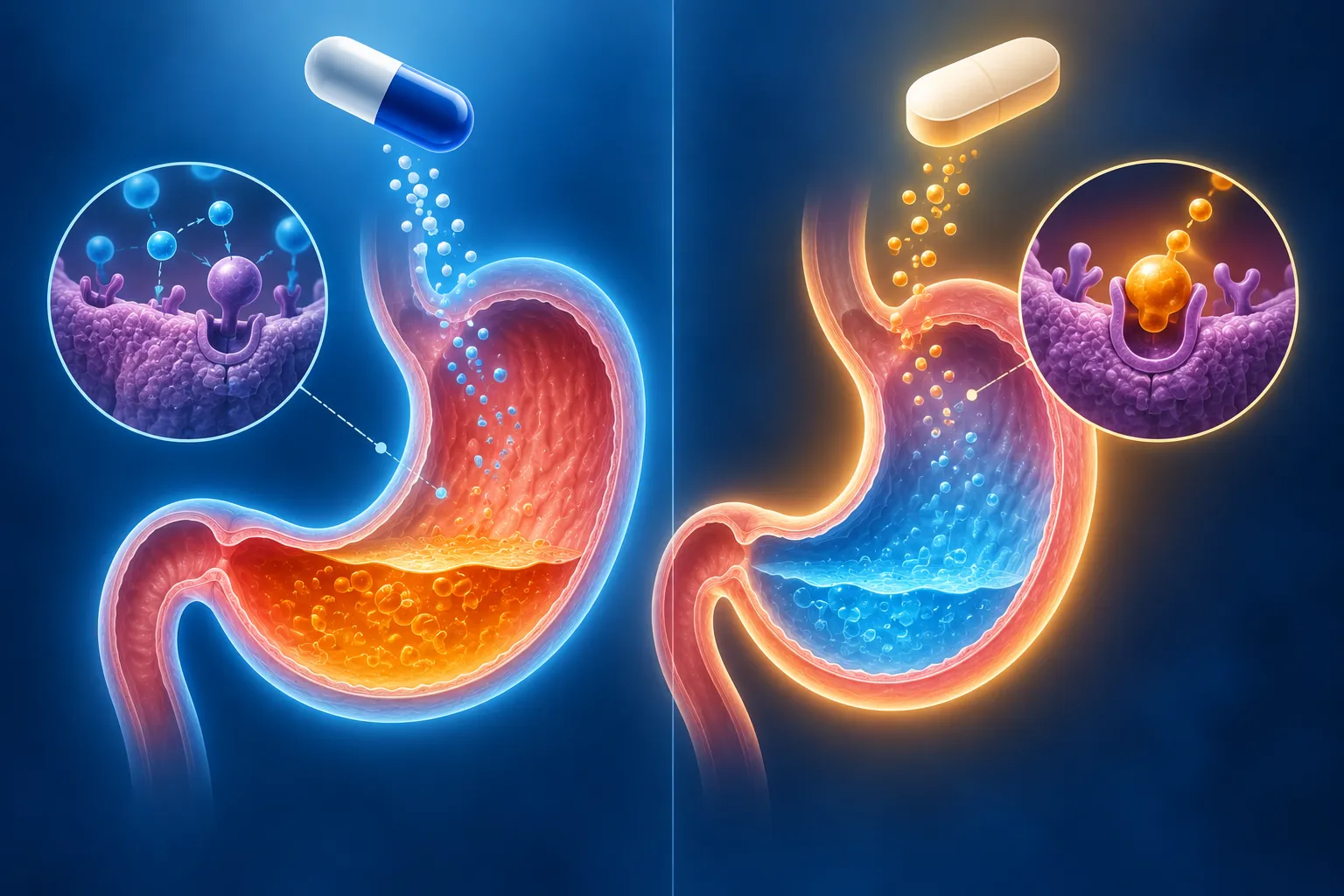
Omeprazole and vonoprazan switch off the same acid pump in the stomach, but in very different ways. That difference explains almost all of their pros and cons.
Important: not yet authorized in Europe
As of September 2026, no P-CAB has marketing authorization in the European Union, in Spain or in the United Kingdom. Neither vonoprazan nor any of its relatives can be prescribed or bought at a pharmacy there.
I checked this directly against the official sources: the European Medicines Agency only holds a paediatric investigation plan for vonoprazan, which is not an approval, and the Spanish and UK medicines databases return no products with these active ingredients. If you live in the United States or Japan, the picture is different: vonoprazan is available there on prescription. Full details below.
The short version
What they are
- A new class of acid blockers that shuts the acid pump without needing to be activated.
- They work from the first dose and do not need to be taken on an empty stomach.
- The best known is vonoprazan, marketed in Japan since 2015 and approved in the US between 2022 and 2024.
Where they win and where they don't
- They win in severe esophagitis and in clarithromycin-resistant H. pylori.
- No proven advantage in mild reflux, which is most cases.
- They raise gastrin more and have fewer years of safety data than omeprazole.
What if omeprazole isn't working for me? Before looking for a drug you cannot get, there is almost always room to improve the treatment you already have. Here's how.
Before you read on
This article is general information, not a treatment recommendation. Do not change or stop your reflux medication without speaking to your doctor.
The vonoprazan vs omeprazole question is the one I have been asked most since P-CABs started making headlines: is it the replacement for omeprazole, does it work better, and when will it arrive in Spain? The short answer is that it is a genuinely different drug, that it is superior in a few specific situations, that it has not been shown to be better for most people with reflux, and that in Europe, today, it simply is not available.
What a P-CAB is and how it differs from omeprazole
Stomach acid is made by a tiny pump in the parietal cells, known as the proton pump. Omeprazole and vonoprazan both switch it off. The difference lies in how.
Omeprazole: powerful, but the pump has to be switched on
Omeprazole and the other proton pump inhibitors, or PPIs, have been in use since the late 1980s and are among the most studied drugs in medicine.3 They have one quirk that explains many treatment failures. The drug reaches the stomach as an inactive prodrug that is only activated by acid, and it can only block pumps that are working at that moment. That is why it has to be taken 30 to 60 minutes before breakfast, when food switches the pumps on. Taking it at bedtime on an empty stomach, or after eating, throws away a good part of its effect. It also takes several days to reach full strength, and how well it works varies from person to person depending on how the liver breaks it down through an enzyme called CYP2C19.
Vonoprazan: direct blockade, from the first dose
Vonoprazan belongs to the potassium-competitive acid blockers, or P-CABs. Instead of waiting to be activated, it binds straight to the pump by competing with the potassium the pump needs in order to work. It does not depend on acid or on food, it accumulates in the stomach lining, and its effect lasts longer through the day and night.9
The difference shows up clearly in a study that measured stomach pH over 24 hours in healthy volunteers. On the first day of treatment, vonoprazan already achieved more than 80 percent of the effect it would have on day seven. Esomeprazole and rabeprazole, by contrast, reached only about 37 and 39 percent of their final effect. By day seven, vonoprazan was still keeping the stomach above pH 4 for considerably longer than either.2
Vonoprazan was the first modern P-CAB to reach the market, in Japan, where it has been sold since 2015.1 Others have followed, mostly in Asia: tegoprazan, fexuprazan, keverprazan and zastaprazan. The idea itself is not new: earlier attempts were abandoned, which helps explain why regulators are cautious.
Vonoprazan vs omeprazole, head to head
| Feature | Omeprazole (PPI) | Vonoprazan (P-CAB) |
|---|---|---|
| How it blocks the pump | Needs to be activated by acid | Direct blockade, competing with potassium |
| Full effect | After several days | Almost complete from day one |
| Timing with meals | 30 to 60 minutes before breakfast | Does not matter |
| Night-time acid control | Patchy | More sustained |
| Variation between people | High, depends on CYP2C19 | Lower |
| Rise in gastrin | Moderate | Greater |
| Track record | More than 30 years | About 10 years, mainly in Japan |
| Cost | Very cheap, generic | Expensive where marketed |
| Available in the EU, Spain and the UK | Yes | Not authorized |
Where vonoprazan genuinely wins
1. Severe erosive esophagitis
The trial that took vonoprazan to the US compared it with lansoprazole, a PPI very similar to omeprazole, in 1,024 patients with erosive esophagitis. At eight weeks, 92.9 percent had healed on vonoprazan versus 84.6 percent on lansoprazole. The interesting part is where the difference lay: in severe esophagitis, Los Angeles grades C and D, vonoprazan healed 17.6 percentage points more at two weeks and also kept patients healed better over the long term. In mild esophagitis there was little difference.4 If you want to know what those grades mean, I explain them in the guide to peptic esophagitis.
2. Clarithromycin-resistant Helicobacter pylori
This is probably its clearest advantage. The antibiotics we use against H. pylori work much better when the stomach is less acidic, and vonoprazan achieves that more intensely and more steadily. In a randomized trial run in the United States and Europe with 1,046 patients, when the bacterium was resistant to clarithromycin, vonoprazan-based regimens eradicated it in 65.8 and 69.6 percent of cases, against only 31.9 percent with the classic lansoprazole regimen. They were also superior across all patients.8 Meta-analyses point the same way.1415 The American Gastroenterological Association now recommends using a P-CAB instead of a PPI in most eradication regimens, wherever one is available.9
One important caveat: the advantage does not apply equally to the whole class. In a 2024 meta-analysis, tegoprazan triple therapy showed no difference compared with PPI-based regimens.15 In Spain, meanwhile, current PPI-and-bismuth regimens still work very well, as I explain in Helicobacter pylori treatments in 2026.
3. Acid reflux that does not respond to high-dose PPIs
In patients whose esophagitis does not heal despite a properly taken PPI, a meta-analysis of twelve studies found healing rates with vonoprazan of around 90 percent at four weeks.11 The key word in that sentence is esophagitis: proven acid damage. In people with heartburn but no proven acid reflux, a stronger acid blocker has nothing to work on.
4. Speed: night-time symptoms and on-demand use
Because it acts so fast, vonoprazan has been tested in heartburn with a normal endoscopy. Compared with placebo, it increased heartburn-free days from the first or second day of treatment, improved heartburn-free nights, and relieved individual episodes when taken only as symptoms appeared.567 Promising, but note that the comparison was against placebo, not against a PPI. Which brings us to the other side of the scale.
Where it has not been shown to be better
This is the part headlines tend to leave out, and the part that matters most for the majority of people with reflux.
- Reflux without visible damage, or heartburn that has not been investigated. No trial shows it beats a properly taken PPI. The American Gastroenterological Association advises against using it as first choice here.9
- Mild esophagitis, grades A and B. PPIs heal it almost as well, and the same guidance does not recommend P-CABs upfront.9
- Peptic ulcer. Not recommended as first line for treatment or prevention either.9 If that applies to you, see the complete guide to stomach ulcers.
- Against a double-dose PPI. Almost every trial compared vonoprazan with a standard-dose PPI. A network meta-analysis published in 2026, covering 99 trials, concluded that P-CABs do not consistently outperform double-dose PPIs.10
The Korean guidelines updated in 2025, in a country where P-CABs are used every day, organize their use by the type and severity of reflux, distinguishing between non-erosive reflux, mild esophagitis and severe esophagitis.21 And there is a third, very common situation in which no acid blocker helps: when the burning is not caused by acid at all. That is what happens in functional heartburn, in many cases of pharyngeal globus, and in supragastric belching.
Safety: what we know and what we don't
When acid is blocked, the stomach responds by making more gastrin, the hormone that tells it to produce acid. With PPIs this rise is moderate. With vonoprazan, being more potent, it is considerably higher. I explain what a high gastrin level means in elevated gastrin: what does it mean?
The longest study we have, VISION, followed Japanese patients on maintenance treatment for five years. Median gastrin was 625 pg/mL with vonoprazan versus 200 with lansoprazole, and there was more thickening of the stomach lining. But not a single cancer or gastric neuroendocrine tumor appeared, and side effects were comparable.12 Another study found that gastrin rose during the first year and a half and then plateaued, without continuing to climb.13
That is reassuring, but five years is not thirty. With omeprazole we have decades of use and a large three-year randomized trial of more than 17,000 people in which pantoprazole was not linked to any relevant adverse effect apart from a small increase in intestinal infections.17 I cover this in more depth in does omeprazole cause cancer? and in the article on gastric polyps, which sometimes appear with these treatments.
In short
Nothing we know today suggests vonoprazan is dangerous. But there is no basis either for saying it is safer than omeprazole. For now, long-term experience favors the older drug.
The situation in Europe, Spain and the UK
This is where most of the confusion lies, so I checked the official sources in September 2026.
- European Medicines Agency. For vonoprazan there is only a paediatric investigation plan (opens in a new tab), last modified in August 2024. It is a mandatory step for developing a medicine in children, not a marketing authorization. No P-CAB appears in the agency's full list of evaluated medicines.
- Spanish Agency of Medicines and Medical Devices. Its CIMA database (opens in a new tab) lists no product containing vonoprazan, tegoprazan, fexuprazan, keverprazan, zastaprazan or linaprazan. For comparison, omeprazole returns more than 240 products.
- UK Medicines and Healthcare products Regulatory Agency. Its products database (opens in a new tab) returns no results for vonoprazan or tegoprazan, against more than 5,000 for omeprazole.
This is striking because some of the key evidence was generated in Europe: the large H. pylori trial included European patients.8 Even so, there is no authorization to date.
Where they are available
- Japan, since 2015, under the brand name Takecab.1
- United States, as Voquezna: for H. pylori in 2022, erosive esophagitis in 2023 and heartburn without visible damage in 2024, according to the company that markets it.
- Other countries in Asia and Latin America have vonoprazan or other P-CABs such as tegoprazan, which in its pivotal Korean trial healed esophagitis as well as esomeprazole.16
What is coming
Two developments are worth following. Tegoprazan was submitted to the FDA in January 2026, and its company expects a decision in early 2027. And there is a P-CAB developed in Europe, linaprazan glurate, from the Swedish company Cinclus Pharma, which is finishing a phase 3 trial in seven European countries against lansoprazole in severe esophagitis, with results expected at the end of 2026. If they are positive, it would be the natural candidate for a European application. Even so, years usually pass between trial results and a medicine on the pharmacy shelf, so nothing should be expected in the short term.
Meanwhile: how to get the most out of omeprazole
Most of the omeprazole "failures" I see in clinic are not failures of the drug but of how it is taken, or of who it is given to. Before thinking about a drug you cannot get, it is worth going through this:
- Timing. 30 to 60 minutes before breakfast, not on waking without eating afterwards and not at night without dinner after it. If a second dose is needed, before dinner.19
- Dose. In reflux that does not respond, guidelines allow moving to twice daily before declaring the treatment a failure.19
- Diagnosis. If you are no better after eight weeks of doing it properly, the next step is not a different pill but checking whether there really is acid reflux. That is what gastroscopy and pH monitoring are for, interpreted according to the Lyon 2.0 consensus.20 I explain when it makes sense in when to get a gastroscopy.
- Measures that genuinely help. Losing weight if needed, raising the head of the bed, not eating late, and checking whether there is a hiatal hernia. There are more ideas in heartburn tips you don't know.
- And if you no longer need it, stop it. Many people stay on omeprazole for years after the reason for it has gone. Guidelines recommend reviewing regularly whether it is still needed and tapering it gradually.18
For a broader view of long-term options, including endoscopic and surgical ones, read can reflux be cured forever? and the page on gastroesophageal reflux.
Myths about P-CABs
Red flags: see a doctor before switching drugs
If you have any of these symptoms, what matters is not which acid blocker you take but getting assessed by a specialist, most likely with a gastroscopy.
- Difficulty swallowing, or food feeling stuck.
- Unintentional weight loss.
- Vomiting blood, black stools, or anemia on a blood test.
- Persistent vomiting.
- Symptoms starting for the first time after age 50.
- Many years of reflux, especially in overweight men, because of the risk of Barrett's esophagus.
How I see it in clinic
P-CABs are the most interesting advance in acid treatment since PPIs arrived, and when they reach Europe they will have a clear place: severe esophagitis, eradicating resistant H. pylori, and some patients with proven acid reflux that does not respond to high-dose PPIs.
But they are not the answer for most people who come in saying "omeprazole does nothing for me". In that group I almost always find one of three things: a PPI taken the wrong way, a diagnosis that was not acid reflux, or reflux with a mechanical component, such as a large hiatal hernia, that no drug will fully fix. Working out which of the three applies to you is still more useful than waiting for a new drug.
Is omeprazole not working for you?
Before switching drugs, it is worth finding out why. In person in Madrid or by video consultation.
Book an AppointmentRelated reading

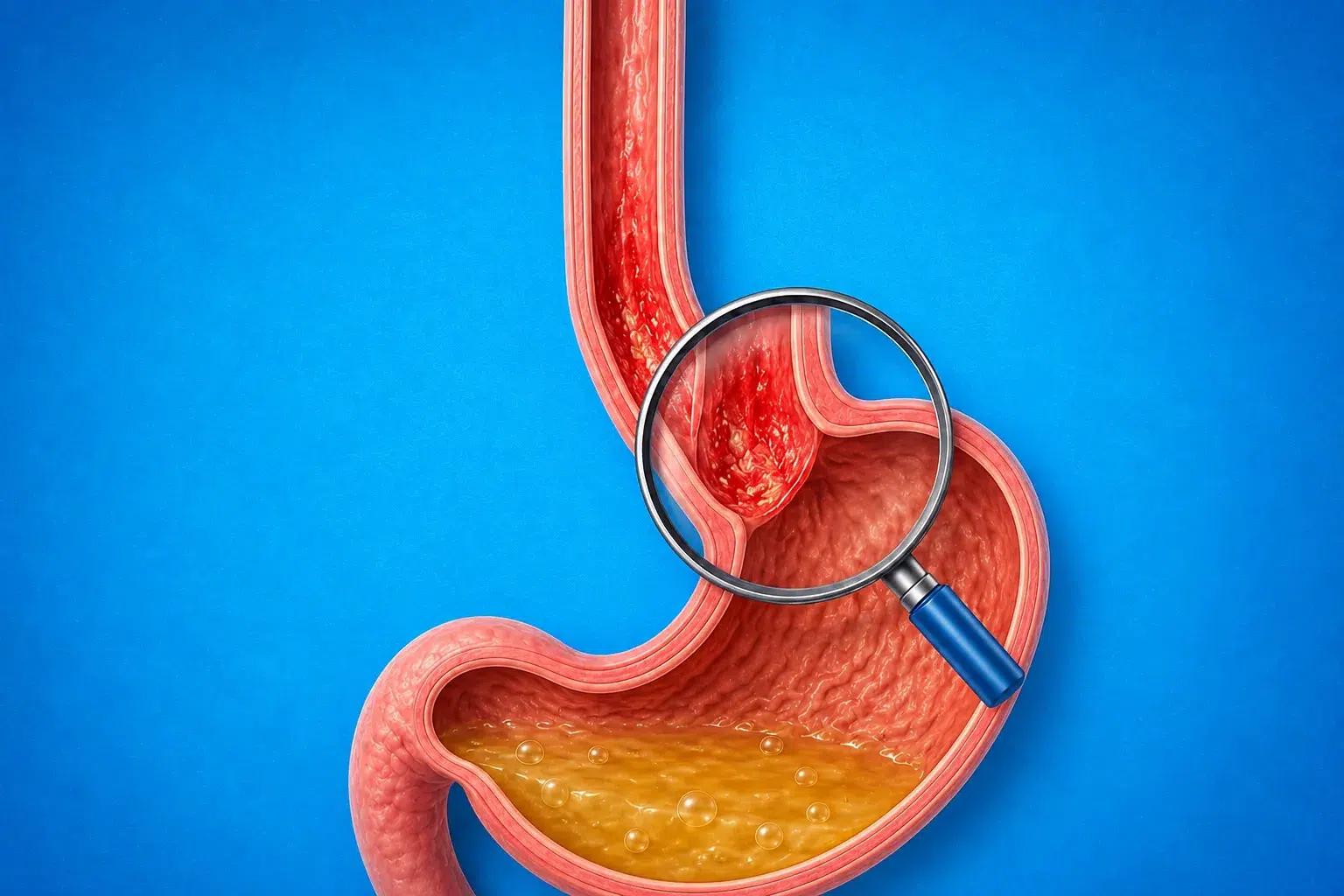

When reflux treatment isn't working, a well-indicated gastroscopy and pH study usually clarify more than switching pills.
Frequently asked questions
Is vonoprazan available in Spain or elsewhere in Europe?
No. As of September 2026, vonoprazan has no marketing authorization in the European Union, in Spain or in the United Kingdom, and neither does any other P-CAB. The European Medicines Agency only holds a paediatric investigation plan for it, which is a development step and not an approval, and neither the Spanish nor the UK medicines databases list any product containing it. It is, however, available on prescription in the United States and Japan.
Is vonoprazan better than omeprazole?
It blocks acid faster and more powerfully, but that does not make it better for everyone. It has shown clear advantages in severe erosive esophagitis, in eradicating clarithromycin-resistant Helicobacter pylori, and in some patients with proven acid reflux that does not respond to high-dose omeprazole. In mild reflux or reflux without visible damage, which covers most patients, no trial has shown it beats a properly taken proton pump inhibitor, and a 2026 network meta-analysis of 99 trials concluded that P-CABs do not consistently outperform double-dose PPIs.
Can I buy vonoprazan online or bring it from another country?
I would not recommend it. An unauthorized medicine bought online comes with no guarantee of content, dose or quality, and vonoprazan also interacts with several commonly used drugs. If a specialist decides your case genuinely needs stronger acid suppression, there are authorized ways to achieve it with the medicines already available, such as adjusting the timing and dose of your proton pump inhibitor or splitting it into two daily doses.
Is vonoprazan safer than omeprazole in the long term?
We do not know yet, and it is worth saying so plainly. Vonoprazan raises gastrin considerably more than proton pump inhibitors, although a five-year Japanese study found no tumors or malignant changes. Omeprazole, on the other hand, has more than thirty years of use behind it, and a large three-year randomized trial found no adverse effects beyond a small increase in intestinal infections. For now, long-term experience favors omeprazole.
References
- Garnock-Jones KP. Vonoprazan: first global approval. Drugs. 2015;75(4):439-443. PubMed (opens in a new tab)
- Sakurai Y, et al. Acid-inhibitory effects of vonoprazan 20 mg compared with esomeprazole 20 mg or rabeprazole 10 mg in healthy adult male subjects: a randomised open-label cross-over study. Aliment Pharmacol Ther. 2015;42(6):719-730. PubMed (opens in a new tab)
- Strand DS, et al. 25 Years of Proton Pump Inhibitors: A Comprehensive Review. Gut Liver. 2017;11(1):27-37. PubMed (opens in a new tab)
- Laine L, et al. Vonoprazan Versus Lansoprazole for Healing and Maintenance of Healing of Erosive Esophagitis: A Randomized Trial. Gastroenterology. 2023;164(1):61-71. PubMed (opens in a new tab)
- Laine L, et al. Vonoprazan is Efficacious for Treatment of Heartburn in Non-erosive Reflux Disease: A Randomized Trial. Clin Gastroenterol Hepatol. 2024;22(11):2211-2220.e10. PubMed (opens in a new tab)
- Fass R, et al. Randomised clinical trial: Efficacy and safety of on-demand vonoprazan versus placebo for non-erosive reflux disease. Aliment Pharmacol Ther. 2023;58(10):1016-1027. PubMed (opens in a new tab)
- Antunes C, et al. Vonoprazan Improves Nocturnal Gastroesophageal Reflux Symptoms in Nonerosive Reflux Disease. Am J Gastroenterol. 2026;121(8):1866-1874. PubMed (opens in a new tab)
- Chey WD, et al. Vonoprazan Triple and Dual Therapy for Helicobacter pylori Infection in the United States and Europe: Randomized Clinical Trial. Gastroenterology. 2022;163(3):608-619. PubMed (opens in a new tab)
- Patel A, et al. AGA Clinical Practice Update on Integrating Potassium-Competitive Acid Blockers Into Clinical Practice: Expert Review. Gastroenterology. 2024;167(6):1228-1238. PubMed (opens in a new tab)
- Simadibrata DM, et al. Potassium-competitive acid blockers and proton-pump inhibitors for the healing and maintenance of erosive esophagitis: a comprehensive and updated systematic review with network meta-analysis. Esophagus. 2026; published online ahead of print. PubMed (opens in a new tab)
- Simadibrata DM, et al. A systematic review and meta-analysis of the efficacy of vonoprazan for proton pump inhibitor-resistant gastroesophageal reflux disease. J Gastroenterol Hepatol. 2024;39(5):796-805. PubMed (opens in a new tab)
- Uemura N, et al. Vonoprazan as a Long-term Maintenance Treatment for Erosive Esophagitis: VISION, a 5-Year, Randomized, Open-label Study. Clin Gastroenterol Hepatol. 2025;23(5):748-757.e5. PubMed (opens in a new tab)
- Shinozaki S, et al. Long-term changes in serum gastrin levels during standard dose vonoprazan therapy. Scand J Gastroenterol. 2022;57(12):1412-1416. PubMed (opens in a new tab)
- Malfertheiner P, et al. Potassium-Competitive Acid Blocker and Proton Pump Inhibitor-Based Regimens for First-Line Helicobacter pylori Eradication: A Network Meta-Analysis. Gastro Hep Adv. 2022;1(5):824-834. PubMed (opens in a new tab)
- Kanu JE, et al. Treatment of Helicobacter pylori with potassium competitive acid blockers: A systematic review and meta-analysis. World J Gastroenterol. 2024;30(9):1213-1223. PubMed (opens in a new tab)
- Lee KJ, et al. Randomised phase 3 trial: tegoprazan, a novel potassium-competitive acid blocker, vs. esomeprazole in patients with erosive oesophagitis. Aliment Pharmacol Ther. 2019;49(7):864-872. PubMed (opens in a new tab)
- Moayyedi P, et al. Safety of Proton Pump Inhibitors Based on a Large, Multi-Year, Randomized Trial of Patients Receiving Rivaroxaban or Aspirin. Gastroenterology. 2019;157(3):682-691.e2. PubMed (opens in a new tab)
- Targownik LE, et al. AGA Clinical Practice Update on De-Prescribing of Proton Pump Inhibitors: Expert Review. Gastroenterology. 2022;162(4):1334-1342. PubMed (opens in a new tab)
- Katz PO, et al. ACG Clinical Guideline for the Diagnosis and Management of Gastroesophageal Reflux Disease. Am J Gastroenterol. 2022;117(1):27-56. PubMed (opens in a new tab)
- Gyawali CP, et al. Updates to the modern diagnosis of GERD: Lyon consensus 2.0. Gut. 2024;73(2):361-371. PubMed (opens in a new tab)
- Huh CW, et al. 2025 Focused Update of the Seoul Consensus on Gastroesophageal Reflux Disease: Evidence-based Recommendations on Acid Suppressive Therapy. J Neurogastroenterol Motil. 2026;32(1):7-18. PubMed (opens in a new tab)
Regulatory status checked on 23 September 2026 in the European Medicines Agency database, the Spanish CIMA database and the UK MHRA products database. US approval dates and the timelines for tegoprazan and linaprazan glurate come from official company announcements.
Is your reflux not improving on treatment?
You don't need to wait for a new drug to get better. Let's find out why the current one isn't working for you.
Book an Appointment
Transparency: this article is not sponsored and promotes no brand or product. All sources are listed and linked above.