

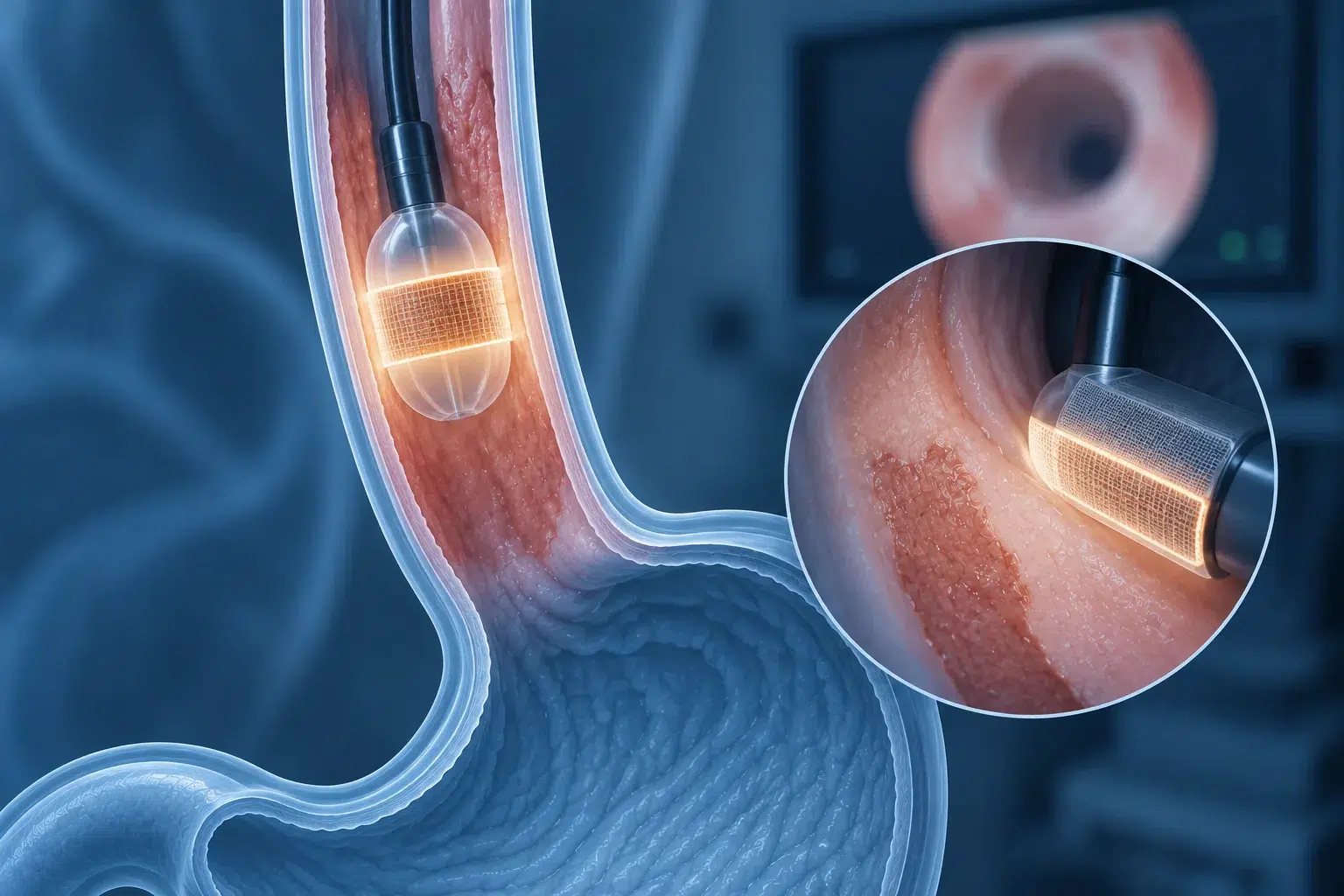
Radiofrequency ablation for Barrett's esophagus is the most studied endoscopic treatment for clearing dysplasia before it turns into cancer. Here I explain who it is for, what it involves, what you will feel afterwards, its risks and how often you need check-ups, according to European, British and US guidelines.
What is radiofrequency ablation?
In Barrett's esophagus, reflux has replaced the normal lining at the lower end of the esophagus with a lining that resembles the intestine. In some people that lining develops dysplasia, cell changes that can progress to cancer. Radiofrequency ablation applies controlled heat to a very thin layer of the lining and destroys that tissue. As it heals, the esophagus is covered again by normal lining.
It is done during an endoscopy. Long segments are treated with a balloon that covers the whole circumference of the esophagus, and small areas with an electrode mounted on the tip of the endoscope. The US AGA guidance advises treating all visible Barrett's plus a 5-10 mm margin above and below.5
The first two figures come from a meta-analysis of 3,802 patients,10 the third from a European trial in low-grade dysplasia8 and the fourth from a meta-analysis of complications in more than 9,000 patients.13
Who is it recommended for?
People with dysplasia. If your Barrett's has no dysplasia, guidelines recommend watching it with regular endoscopies instead of treating it.16
| Situation | Recommendation |
|---|---|
| Barrett's without dysplasia | Surveillance: every 5 years if 1-3 cm long and every 3 years if 3-10 cm (ESGE) |
| Confirmed low-grade dysplasia | Ablation (ESGE, ACG and BSG); the AGA also accepts continued surveillance |
| High-grade dysplasia without a visible lesion | Ablation |
| Visible lesion with dysplasia or early cancer | Remove it first by endoscopic resection, then treat the rest of the Barrett's with ablation |
Low-grade dysplasia is hard to diagnose, which is why the European guideline (ESGE) asks for it to be seen on at least two endoscopies and confirmed by a second experienced pathologist.1 The 2018 British recommendation cites a study in which only 27% of low-grade dysplasia diagnoses were confirmed on review. In the confirmed cases, the risk of progression was 9.1% a year.4 The American College of Gastroenterology (ACG) also recommends treating it,2 while the AGA considers both treatment and continued surveillance reasonable and suggests deciding with the patient.5
If there is a raised or irregular area, ablation is not enough. That lesion is removed first by endoscopic mucosal resection or submucosal dissection, and the remaining Barrett's is then cleared with radiofrequency.15 If you are not yet sure what type of Barrett's you have, start with reflux and Barrett's esophagus.
What the treatment involves
It is an endoscopy under sedation, with no incisions and, in most cases, no hospital stay. One session is rarely enough: in the Dutch national series, the median was one balloon session and two focal sessions per patient.11 Between sessions the esophagus is allowed to heal and the result is checked before repeating.
It should be done by an experienced team: the British guideline asks for it to be done in high-volume centers,3 the AGA sets a minimum of 10 new cases a year5 and the ACG also includes volume criteria.2 It is only applied to flat Barrett's, without inflammation and without visible lesions.5
What you will feel afterwards
Some discomfort is normal. In a Dutch study using symptom diaries, there was chest pain after 95% of sessions, with a median of 14 days, and it was severe after 64%, for about 8 days. Difficulty swallowing followed 83% of sessions and lasted a median of 13 days. Pain was greater with long Barrett's segments, in younger people and after the first session.14
That is why it helps to start with a liquid or soft diet and pain relief, and to keep taking the reflux treatment your doctor prescribes. The AGA recommends a daily proton pump inhibitor in Barrett's esophagus to reduce the risk of progression.6
Risks
The most common complication is stricture, a narrowing of the esophagus that makes swallowing difficult. In the meta-analysis of 9,200 patients it occurred in 5.6%; bleeding in 1% and perforation in 0.6%. The risk was about four times higher when ablation was combined with endoscopic resection.13 In the Dutch series, where 62% had a prior resection, stricture reached 15%.11 It is almost always solved with dilation: in the low-grade dysplasia trial, every stricture resolved this way, with a median of one session.8
Does it work? What the trials show
The first large randomized trial, published in the New England Journal of Medicine, compared ablation with a sham procedure. It cleared low-grade dysplasia in 90.5% of patients and high-grade dysplasia in 81%, and cut cancers from 9.3% to 1.2%.7
For low-grade dysplasia, the European SURF trial was stopped early because ablation was clearly better than surveillance.8 After about six years of follow-up, 1.5% of treated patients progressed to high-grade dysplasia or cancer, versus 33.8% of those under surveillance: about three people needed treatment to prevent one case.9
Barrett's can come back, almost always as small islands that are treated again. In the UK registry, at 8 years Barrett's had returned in 18.7% and dysplasia in 5.9%, mostly in the first two years, and most cases responded to retreatment. At 10 years, the cumulative cancer risk was 4.1%.12 In the Dutch series, dysplasia returned in 3% (1% a year), and every recurrence was visible at endoscopy.11 What is found in the first year is usually disease that was left untreated rather than a true recurrence.15
Follow-up afterwards
After Barrett's has been cleared, endoscopies continue. The European guideline recommends that the first check-up take place in an experienced center, with a high-definition endoscope and virtual chromoendoscopy, and with biopsies targeted at anything that looks abnormal.1
| Diagnosis before treatment | Follow-up endoscopies |
|---|---|
| Low-grade dysplasia | At 1, 3 and 5 years; then they can stop |
| High-grade dysplasia or early cancer | At 1, 2, 3, 4, 5, 7 and 10 years; then they can stop |
The US AGA proposes more frequent early check-ups for high-grade dysplasia (at 3, 6 and 12 months, then yearly).5 Your gastroenterologist will tailor the schedule to your case.
Are there alternatives?
There are other ablation techniques, such as cryotherapy or hybrid argon plasma coagulation. A randomized trial published in September 2026 compared radiofrequency with hybrid argon in dysplastic Barrett's. Dysplasia clearance was the same (90.3% in both), and argon caused less pain, less difficulty swallowing and fewer strictures (3.2% versus 19.4%), although the study was small.16 Radiofrequency is still the technique with the longest follow-up.
Common myths
When to call or go to the emergency department
After an ablation session, seek help without waiting if you have:
- Chest pain that gets worse instead of better.
- Fever or difficulty breathing.
- Vomiting blood or black stools.
- Inability to swallow even liquids.
- Difficulty swallowing that returns weeks later, after you had improved: it may be a stricture.
How I approach it in practice
Before treating, I review the biopsies with an expert pathologist and repeat the endoscopy with high definition and chromoendoscopy to rule out visible lesions. If there are any, I remove them first. Then we plan the radiofrequency sessions and the follow-up schedule. There is more information on Barrett's esophagus treatment and on chromoendoscopy.
Found dysplasia in your Barrett's?
We review your biopsies and explain whether treatment makes sense for you. In Madrid or by video consultation.
Book an AppointmentRelated reading


Before ablation, a high-definition endoscopy with chromoendoscopy rules out lesions that need to be removed first.
Frequently asked questions
Does radiofrequency ablation for Barrett's esophagus hurt?
Not during the endoscopy, because it is done under sedation. Afterwards, chest pain and difficulty swallowing for one or two weeks are common. In a study using symptom diaries, pain lasted a median of 14 days and was severe for about 8 days.
How many sessions are needed?
It depends on the length of the Barrett's. Two or three sessions are usual: in the Dutch national series, the median was one balloon session and two focal sessions per patient.
Does radiofrequency cure Barrett's esophagus?
It clears dysplasia in about 91% of cases and all Barrett's in about 78%. It can come back, almost always as small islands that are treated again, which is why follow-up is needed.
What are the risks?
The most common is narrowing of the esophagus, in about 5.6%, which is almost always solved with dilation. Bleeding occurs in 1% and perforation in 0.6%.
Do I need check-ups after ablation?
Yes. The European guideline recommends endoscopies at 1, 3 and 5 years after low-grade dysplasia, and at 1, 2, 3, 4, 5, 7 and 10 years after high-grade dysplasia or early cancer.
References
- Weusten BLAM, et al. Diagnosis and management of Barrett esophagus: European Society of Gastrointestinal Endoscopy (ESGE) Guideline. Endoscopy. 2023;55(12):1124-1146. PubMed (opens in a new tab)
- Shaheen NJ, et al. Diagnosis and Management of Barrett's Esophagus: An Updated ACG Guideline. Am J Gastroenterol. 2022;117(4):559-587. PubMed (opens in a new tab)
- Fitzgerald RC, et al. British Society of Gastroenterology guidelines on the diagnosis and management of Barrett's oesophagus. Gut. 2014;63(1):7-42. PubMed (opens in a new tab)
- di Pietro M, et al. Revised British Society of Gastroenterology recommendation on the diagnosis and management of Barrett's oesophagus with low-grade dysplasia. Gut. 2018;67(2):392-393. PubMed (opens in a new tab)
- Sharma P, et al. AGA Clinical Practice Update on Endoscopic Treatment of Barrett's Esophagus With Dysplasia and/or Early Cancer: Expert Review. Gastroenterology. 2020;158(3):760-769. PubMed (opens in a new tab)
- Wani S, et al. AGA Clinical Practice Guideline on Surveillance of Barrett's Esophagus. Gastroenterology. 2025;169(6):1184-1231. PubMed (opens in a new tab)
- Shaheen NJ, et al. Radiofrequency ablation in Barrett's esophagus with dysplasia. N Engl J Med. 2009;360(22):2277-88. PubMed (opens in a new tab)
- Phoa KN, et al. Radiofrequency ablation vs endoscopic surveillance for patients with Barrett esophagus and low-grade dysplasia: a randomized clinical trial. JAMA. 2014;311(12):1209-17. PubMed (opens in a new tab)
- Pouw RE, et al. Radiofrequency ablation for low-grade dysplasia in Barrett's esophagus: long-term outcome of a randomized trial. Gastrointest Endosc. 2020;92(3):569-574. PubMed (opens in a new tab)
- Orman ES, et al. Efficacy and durability of radiofrequency ablation for Barrett's Esophagus: systematic review and meta-analysis. Clin Gastroenterol Hepatol. 2013;11(10):1245-55. PubMed (opens in a new tab)
- van Munster S, et al. Long-term outcomes after endoscopic treatment for Barrett's neoplasia with radiofrequency ablation ± endoscopic resection: results from the national Dutch database in a 10-year period. Gut. 2022;71(2):265-276. PubMed (opens in a new tab)
- Wolfson P, et al. Endoscopic eradication therapy for Barrett's esophagus-related neoplasia: a final 10-year report from the UK National HALO Radiofrequency Ablation Registry. Gastrointest Endosc. 2022;96(2):223-233. PubMed (opens in a new tab)
- Qumseya BJ, et al. Adverse Events After Radiofrequency Ablation in Patients With Barrett's Esophagus: A Systematic Review and Meta-analysis. Clin Gastroenterol Hepatol. 2016;14(8):1086-1095.e6. PubMed (opens in a new tab)
- Overwater A, et al. The course of pain and dysphagia after radiofrequency ablation for Barrett's esophagus-related neoplasia. Endoscopy. 2023;55(3):255-260. PubMed (opens in a new tab)
- Sawas T, et al. Higher Rate of Barrett's Detection in the First Year After Successful Endoscopic Therapy: Meta-analysis. Am J Gastroenterol. 2018;113(7):959-971. PubMed (opens in a new tab)
- Klimkowski R, et al. Radiofrequency ablation versus hybrid argon plasma coagulation for dysplastic Barrett's esophagus: a randomized-controlled trial assessing procedural tolerability and safety (RATE study). Gastrointest Endosc. 2026;. PubMed (opens in a new tab)