
Published 25 September 2026
Positive Fecal Occult Blood Test (FOBT): Everything You Need to Know
Your screening letter came back positive. What it really means, how likely it is to be something serious, why repeating the test doesn't help, and how long you can safely wait for your colonoscopy.

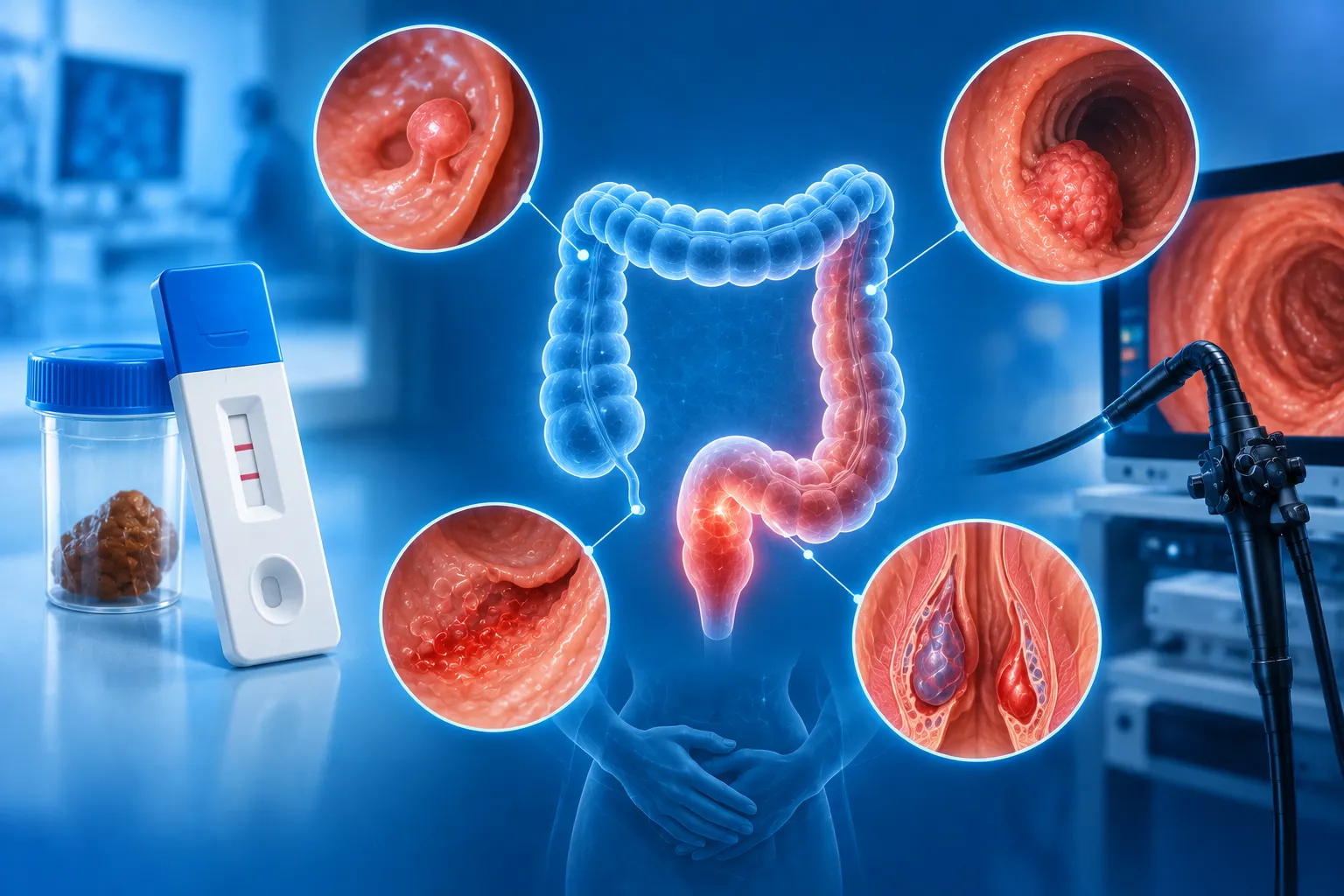
A positive occult blood test only tells us there is a trace of blood in the stool. Finding out where it comes from means looking inside the colon: a colonoscopy.
Key points
What it means
- The test found human haemoglobin in your stool above a set threshold. It is not a diagnosis.
- Out of 100 people with a positive test, about 4 have cancer and roughly a third have advanced polyps that should be removed.
- When screening finds a cancer, 7 in 10 are at an early stage.
What to do
- Have a colonoscopy. It is the only next step that makes sense.
- Don't repeat the test to "confirm" it: a second negative does not cancel the first positive.
- It is not an emergency, but don't let months go by: risk rises when colonoscopy is delayed beyond 6–9 months.
Most people with a positive test do not have cancer. That is exactly why screening works: it finds polyps before they turn into one.
Before you read on
This article is general information for patients. It does not replace your doctor's assessment or your screening programme's instructions. If you have symptoms, see a doctor even if your test was negative.
Getting a letter saying your fecal occult blood test is positive is frightening. It is one of the most common reasons patients come to see me, and it almost always comes with the same question: "Do I have cancer?" In the vast majority of cases, the answer is no. But a positive test is not a false alarm you can ignore either. It is a sign that something in the colon deserves a look, and very often that something is a polyp which, removed in time, will never become a problem.
What the fecal occult blood test is
It is called "occult" because the amount of blood is too small to see. The test used in screening programmes today is the fecal immunochemical test, or FIT. It uses antibodies that recognise the globin in human haemoglobin, which has three practical consequences:
- No special diet is needed. Red meat, vegetables or iron supplements do not cause false positives, as they did with the old guaiac tests.
- It is fairly specific to the colon. Blood from the stomach is digested on the way down and the test barely picks it up. A positive FIT points to the large bowel and rectum.
- It is quantitative. The lab measures the concentration of haemoglobin, and the result is positive above a threshold, usually 20 micrograms per gram of stool in Spanish programmes.10
In Spain, public programmes invite men and women aged 50 to 74 with no symptoms or risk factors every two years, although in some regions the upper age limit is still 69.11 It is a simple, well-studied test: it detects about 8 in 10 colorectal cancers and is negative in about 94 in 100 healthy people.1 It is less sensitive for polyps, which is why it is repeated every two years.
If you want to understand how it compares with going straight to colonoscopy, I explain it in colonoscopy vs fecal occult blood test.
What a positive result means
It means your sample contained more haemoglobin than expected and we need to find out where it comes from. No more, no less. To put it in perspective, these are the 2023 results of the Basque Country screening programme, one of the best-reported programmes in Spain:10
In other words, if your test was positive today, the colonoscopy will most likely find polyps or nothing significant. The chance of cancer is real, and higher than in the general population, but it is low. And when cancer is found, it is usually at a curable stage.
The polyp figure is the one I care about most. An advanced adenoma is not cancer, but it is the most common precursor. Removing it during the same colonoscopy is the main reason screening lowers not only deaths from colorectal cancer but also the number of people who develop it in the first place.
What the colonoscopy usually finds
The table below is an approximation, calculated from the 2023 detection data of the Basque programme. The figures shift somewhat with age, sex and test threshold, but the overall pattern is similar across European programmes.10
| Finding | Out of 100 | What it means |
|---|---|---|
| No polyps or significant lesions | ~40 | You go back to routine screening. Bleeding is usually from haemorrhoids, diverticula or small vascular lesions. |
| Low-risk adenomas | ~18 | Removed during the same procedure. Usually back to screening or a long-interval check. |
| Advanced lesions (large or high-risk adenomas) | ~36 | Removed during the same or a planned procedure. A follow-up colonoscopy is needed. |
| Colorectal cancer | ~4 | Staging and treatment. Most are found at an early stage. |
Besides polyps, other benign causes can make the test positive: haemorrhoids, anal fissures, diverticula, angiodysplasias (small dilated vessels in the bowel wall) or inflammatory bowel disease that had not yet shown itself. All of them are visible on colonoscopy, and some can be treated during it.
Why repeating the test doesn't help
It is the most common temptation, sometimes suggested with the best of intentions: "Repeat it, maybe it was a mistake." Don't. Polyps and tumours bleed intermittently. A second negative test only means they weren't bleeding that day, not that they aren't there.
Professional societies are clear on this: after a positive FIT, the next step is colonoscopy, not another FIT.2 The same goes for "it must be the piles". Haemorrhoids are very common after 50, and having them does not rule out a polyp further up. Many of the significant lesions I find at colonoscopy are in patients who already knew they had haemorrhoids.
How long can I wait for the colonoscopy?
This is the most important practical question, and there is good evidence to answer it:
- In a study of more than 70,000 people with a positive FIT in California, having the colonoscopy within 9 months did not increase risk compared with having it in the first month. From 10 months onwards, the risk of cancer rose by about 50% and the risk of advanced cancer almost doubled. Beyond 12 months, the risk of advanced cancer tripled.3
- A meta-analysis of six studies with more than 360,000 patients found that delays of more than 6 months were associated with more cancers and more advanced-stage cancers.4
- In more than 200,000 US veterans, delaying colonoscopy beyond a year was linked not only to more cancers but also to higher mortality.5
That is why screening programmes aim to perform the colonoscopy within the first few weeks after the result.12 A few weeks' wait changes nothing. Several months does.
In short
It is not an emergency and you don't need to go to hospital today. But it is not something for "when I find the time" either. If your appointment is delayed by several months, ask your centre or look for alternatives.
What the colonoscopy after a positive test involves
It is the same procedure as any other colonoscopy, with one difference: we are quite likely to find something to remove. That is why doing it well matters so much.
Bowel preparation is everything
A poorly cleaned colon hides polyps. Following the diet in the days before and taking the laxative solution in two doses, the last one a few hours before the procedure, is what makes the biggest difference to how useful the colonoscopy is. I have built an interactive colonoscopy preparation app that guides you step by step.
Sedation and polyp removal in one go
The procedure is done under sedation, so it won't be an ordeal. Any polyps we find are removed there and then in the vast majority of cases, and sent for analysis. Only some large or complex lesions are scheduled for a second session with specialised techniques.
Is it risky?
It is a very safe procedure. In large population studies, serious complications are uncommon: about 1 perforation per 2,000 colonoscopies and around 3 bleeds per 1,000, almost always after polyp removal and mostly controlled during the endoscopy itself.9 With a positive test, the risk of not having it is clearly greater.
Not all colonoscopies are equal: the endoscopist's adenoma detection rate, the quality of the bowel preparation and reaching the end of the colon all make a difference. I explain why in why you should care about getting a quality colonoscopy.
Has your occult blood test come back positive?
I can see you and, if needed, perform your colonoscopy without long waits in Madrid. Online consultations are also available to review your case.
Book an AppointmentIf you take aspirin or blood thinners
A very common question: "Could it be positive because of my anticoagulant?" Antiplatelet drugs and anticoagulants can make small, harmless lesions bleed a little more, and studies show they slightly increase false positives.6 But they are far from explaining every positive result: advanced adenomas and cancers are also found in people taking them.
The practical takeaway is twofold:
- A positive test while on blood thinners still needs a colonoscopy.
- Do not stop your medication on your own. Whether to pause it before the procedure, and for how many days, depends on the drug and why you take it, following European guidelines.7 Many patients on aspirin, for example, don't need to stop it.
What if the colonoscopy is normal?
If the colonoscopy reached the end of the colon, with good preparation, and found no significant lesions, you can relax. The test was not "wrong": it probably picked up benign bleeding, such as haemorrhoids or a diverticulum.
- No further tests are routinely needed. In people without symptoms or anaemia, a gastroscopy is not indicated just because of the positive test.2
- You return to screening later on. After a normal colonoscopy or one with only small low-risk adenomas, screening is usually not repeated for about 10 years.8
- If higher-risk polyps were removed, you will be offered a follow-up colonoscopy, usually at 3 years, depending on their number, size and pathology.8
If, on the other hand, you have iron-deficiency anaemia or digestive symptoms, further investigation may be needed. That is an individual assessment.
Four myths about the occult blood test
Red flags: see a doctor even if your test is negative
Screening is for people without symptoms. If you have any of these, don't wait for your next screening letter: get checked.
- Visible blood in the stool, or black stools.
- A persistent change in bowel habit lasting several weeks, especially after 50.
- Iron-deficiency anaemia or unexplained tiredness.
- Unintentional weight loss.
- Persistent abdominal pain or a feeling of incomplete emptying.
- Close relatives with colorectal cancer, especially if diagnosed before 60: in that case the right screening is usually colonoscopy, not the stool test.
How I approach it in my clinic
When a patient comes in with a positive occult blood test, the first thing is to take the fear out of it with facts, and the second is not to waste time. I review their medication and history, explain the preparation in detail and schedule the colonoscopy as soon as possible, under sedation, aiming to remove everything we find in the same procedure.
Afterwards, I go through what I saw with the images in front of us. And when the pathology report arrives, I tell them exactly when their next check is due, if one is needed at all.
Related reading



Frequently asked questions
Does a positive fecal occult blood test mean I have cancer?
No. In Spanish screening programmes, about 4 in 100 people with a positive test have colorectal cancer, and when it is found it is usually at an early stage. The most common findings are polyps, which are removed during the same colonoscopy, or no significant lesion at all.
Can I repeat the occult blood test to confirm the result?
It is not recommended. Polyps and tumours bleed intermittently, so a second negative test rules nothing out. After a positive fecal immunochemical test, the appropriate next step is a colonoscopy.
How long can I wait for a colonoscopy after a positive test?
A few weeks' wait does not change the outlook, and programmes aim to perform it within the first month. Studies show that the risk of cancer and advanced cancer rises when colonoscopy is delayed beyond 6 to 9 months, and mortality rises when it is delayed beyond a year.
Can haemorrhoids cause a positive occult blood test?
Yes, they can. But having haemorrhoids does not rule out a polyp or tumour further up the colon, so they should not be used as a reason to skip the colonoscopy.
Do I need to stop blood thinners or aspirin before the colonoscopy?
It depends on the drug and why you take it. Never stop it on your own: before the procedure your doctor will tell you whether to pause it and for how many days, following European guidelines. Many patients on aspirin don't need to stop it.
If the colonoscopy is normal, do I need more tests?
If the colonoscopy was complete and the bowel preparation was good, people without symptoms or anaemia need no further tests, including gastroscopy. You will usually return to screening after about 10 years.
References
- Lee JK, Liles EG, Bent S, Levin TR, Corley DA. Accuracy of fecal immunochemical tests for colorectal cancer: systematic review and meta-analysis. Ann Intern Med. 2014;160(3):171-181. DOI (opens in a new tab)
- Robertson DJ, Lee JK, Boland CR, et al. Recommendations on fecal immunochemical testing to screen for colorectal neoplasia: a consensus statement by the US Multi-Society Task Force on Colorectal Cancer. Gastroenterology. 2017;152(5):1217-1237. PubMed (opens in a new tab)
- Corley DA, Jensen CD, Quinn VP, et al. Association between time to colonoscopy after a positive fecal test result and risk of colorectal cancer and cancer stage at diagnosis. JAMA. 2017;317(16):1631-1641. PubMed (opens in a new tab)
- Mutneja HR, Bhurwal A, Arora S, Vohra I, Attar BM. A delay in colonoscopy after positive fecal tests leads to higher incidence of colorectal cancer: a systematic review and meta-analysis. J Gastroenterol Hepatol. 2021;36(6):1483-1490. DOI (opens in a new tab)
- San Miguel Y, Demb J, Martinez ME, Gupta S, May FP. Time to colonoscopy after abnormal stool-based screening and risk for colorectal cancer incidence and mortality. Gastroenterology. 2021;160(6):1997-2005.e3. PubMed (opens in a new tab)
- Jung YS, Im E, Park CH. Impact of antiplatelet agents and anticoagulants on the performance of fecal immunochemical tests: a systematic review and meta-analysis. Surg Endosc. 2022;36(6):4299-4311. PubMed (opens in a new tab)
- Veitch AM, Radaelli F, Alikhan R, et al. Endoscopy in patients on antiplatelet or anticoagulant therapy: British Society of Gastroenterology (BSG) and European Society of Gastrointestinal Endoscopy (ESGE) guideline update. Endoscopy. 2021;53(9):947-969. ESGE (opens in a new tab)
- Hassan C, Antonelli G, Dumonceau JM, et al. Post-polypectomy colonoscopy surveillance: European Society of Gastrointestinal Endoscopy (ESGE) Guideline – Update 2020. Endoscopy. 2020;52(8):687-700. ESGE (opens in a new tab)
- Reumkens A, Rondagh EJ, Bakker CM, Winkens B, Masclee AA, Sanduleanu S. Post-colonoscopy complications: a systematic review, time trends, and meta-analysis of population-based studies. Am J Gastroenterol. 2016;111(8):1092-1101. PubMed (opens in a new tab)
- Osakidetza (Basque Health Service). Colorectal cancer screening programme of the Basque Country: 2023 results. Osakidetza (opens in a new tab)
- Spanish Ministry of Health. Colorectal cancer screening programme: general information. Ministry of Health (opens in a new tab)
- European Commission. European guidelines for quality assurance in colorectal cancer screening and diagnosis. 1st ed. Luxembourg: Publications Office of the EU; 2010. European Commission (opens in a new tab)
Sources accessed in September 2026.
Need a colonoscopy after a positive test?
No long waits, under sedation and with quality standards. I explain the results the same day.
Book an Appointment
Transparency: this article is not sponsored and promotes no brand or product. All sources are listed and linked above.