
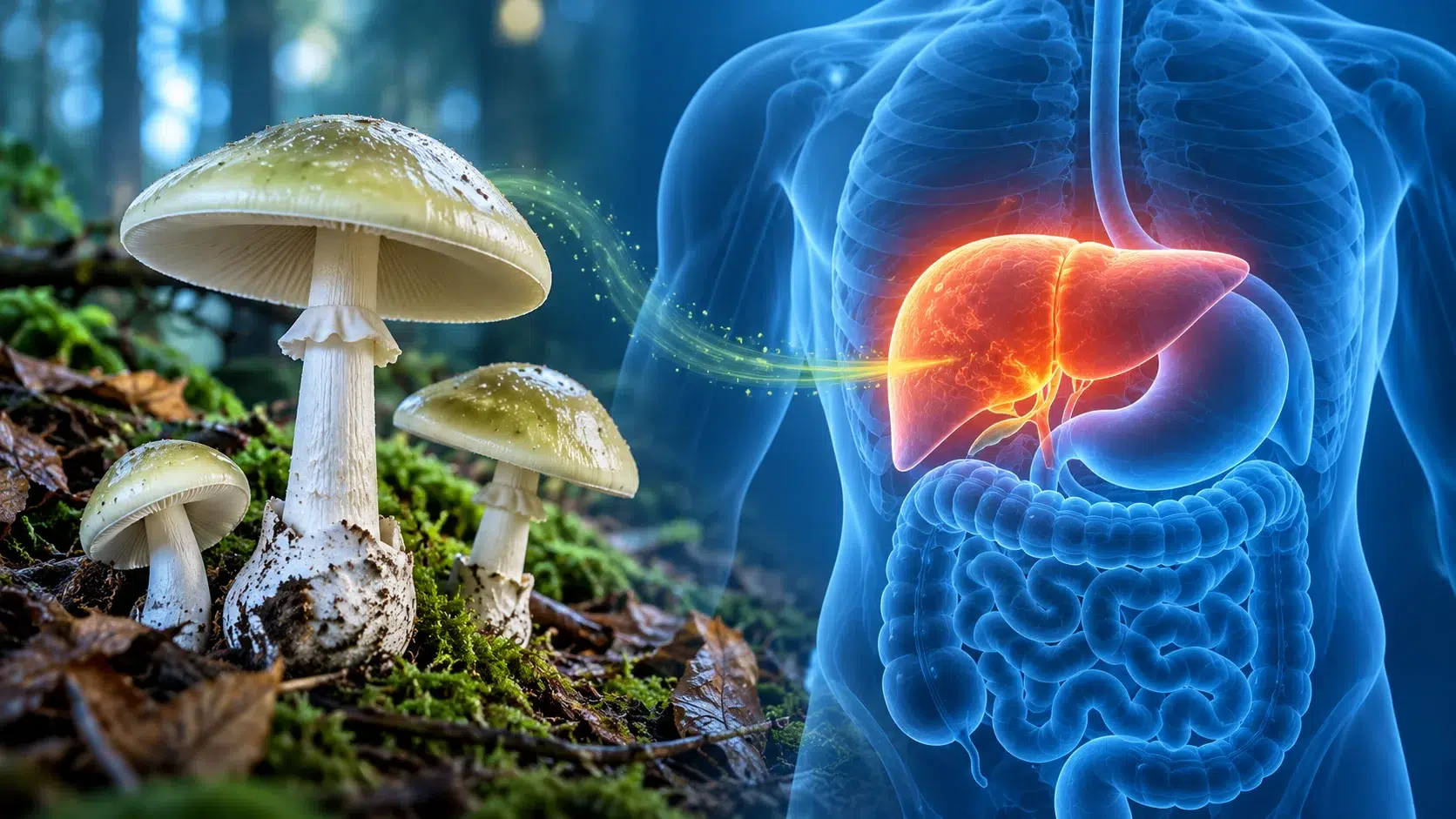
Mushroom poisoning almost always starts with a stomach ache, vomiting or diarrhea, and in most cases it goes no further. What matters most, and many people do not know it, is how much time has passed since the meal. The deadliest mushrooms, such as the death cap, take hours to show themselves, then seem to give a break, and then attack the liver.
What matters most: how long the symptoms take
Mushroom poisonings are classified by the time between the meal and the first symptom. There are early syndromes, starting within 6 hours; late ones, between 6 and 24 hours; and delayed ones, from the first day onwards.1 That timing tells you more than a description of the mushroom, which is rarely known with any accuracy.
When vomiting or diarrhea start within 6 hours, the usual cause is a gastrointestinal syndrome with a benign course. When they take 6 hours or more, the poisoning can be serious: this is what happens with the amatoxins of the death cap (Amanita phalloides), with gyromitrin, with the orellanine in Cortinarius species and with mushrooms that destroy muscle. In Germany, between 2000 and 2018, there were 4,412 hospital admissions and 22 deaths from eating mushrooms, and 90% of those deaths were caused by the death cap.2
The rule has exceptions. Some fast-acting mushrooms, such as those containing muscarine, can cause serious illness in vulnerable people. And if several species were eaten at the same meal, early symptoms can coexist with a late poisoning that has not yet shown itself.3 So if you have eaten wild mushrooms and start vomiting within the hour, you still need to get checked.
Not every autumn diarrhea is the mushrooms' fault either. A viral or bacterial gastroenteritis, as in traveler's diarrhea, can start hours after a meal. The difference is that, if wild mushrooms were on the menu, you cannot assume it is gastroenteritis until amatoxins have been ruled out. If the pain confuses you, the guide to abdominal pain by location can help you place it, but in this situation it does not replace the emergency department.
The death cap and other amatoxin mushrooms
The death cap is responsible for more than 90% of mushroom deaths.4 Amatoxins are not limited to it: they occur in species of Amanita, Lepiota and Galerina. After the death cap, the deadliest are Amanita virosa and Amanita verna; among the Lepiota, Lepiota brunneoincarnata, and among the Galerina, Galerina marginata.56 Some Lepiota species are mistaken for edible mushrooms such as the parasol (Macrolepiota procera).7
The poisoning follows fairly recognizable stages:35
- A few hours without symptoms. The illness usually starts 6 to 8 hours after the meal.
- An intense digestive phase, with repeated vomiting, watery diarrhea and abdominal pain, which can cause severe dehydration.
- A deceptive improvement: symptoms ease, but blood tests start to show liver damage between 24 and 36 hours.
- Between 24 and 72 hours, liver and kidney failure may follow, with clotting problems, encephalopathy and a risk of death.
Severity depends on the amount of mushroom eaten and on how long it takes for treatment to start.5 The second-day improvement is the most treacherous part: it can lead to the illness being mistaken for gastroenteritis and to an early discharge, just as the liver is being damaged.3 Kidney failure is also common.4
There are data from Spain. At the Hospital Clínic in Barcelona, 32 patients with suspected hepatotoxic mushroom poisoning were reviewed between 2002 and 2016. Of the 19 with amatoxins in the urine, 8 developed liver damage and 3 progressed to acute liver failure: 2 died and 1 needed a transplant. A negative urine result within the first 72 hours ruled out liver damage in 92% of cases.8 With modern intensive care, mortality from this poisoning has fallen below 10%.4
Myth or fact? Test what you know
Pick an answer for each statement and see what the evidence says.
1. “If you cook mushrooms well, the poison disappears.”
Myth. Amatoxins resist heat, stomach acid and digestive enzymes. In the laboratory, α-amanitin heated to 90 °C for 16 hours kept its activity, and 76% of the toxin remained after 6 months frozen at -20 °C.79
2. “If snails or slugs eat a mushroom, it is edible.”
Myth. A snail tolerates a dose of amatoxin about 200 times the lethal dose for a person. An animal eating it says nothing about whether it is safe for you.7
3. “A mushroom that smells and tastes good can be deadly.”
Fact. The death cap has a sweet smell and a pleasant taste, and α-amanitin itself has no smell or taste.79
4. “If you feel better the day after vomiting, the worst is over.”
Myth. Amatoxin poisoning has a phase of apparent recovery while liver damage progresses. That phase can lead to it being mistaken for gastroenteritis.35
0 of 6 answered
Other mushroom poisonings worth knowing about
The most common picture is gastrointestinal: abdominal pain, nausea, vomiting and diarrhea 1 to 3 hours after eating.5 A toxic mushroom is not always the cause. Edible mushrooms can also make you ill if they are spoiled, raw or undercooked, or if they are eaten in large amounts or very often.2 At a Swiss poison centre, the most frequent reason for adult calls was illness after eating edible species.10 If nausea persists days later, it no longer fits this picture and should be looked into.
Muscarinic syndrome is caused by Clitocybe and Inocybe species. Between 30 minutes and 2 hours after eating them, sweating, salivation, tearing, vomiting, diarrhea, a slow pulse and excess bronchial secretions appear. It is treated with atropine and usually settles within about 12 hours.5 Although it comes on fast, it can be serious because of bronchospasm and cardiovascular effects.3
Pantherina syndrome is due to the ibotenic acid and muscimol in Amanita muscaria and Amanita pantherina. It affects the nervous system: it starts 30 minutes to 2 hours after the meal and usually lasts less than 24 hours.5 In a Slovenian series, people poisoned by Amanita muscaria were more often confused (26 of 32) and agitated (20 of 32), while those poisoned by Amanita pantherina fell into a coma more often (5 of 17 against 2 of 32).11
The orellanine in some Cortinarius species attacks the kidney after a long delay: kidney failure may appear 3 to 20 days later. It may need hemodialysis, and around 11% of patients are left with end-stage kidney failure which may require a kidney transplant.5 Because the symptoms arrive so late, they are hard to link to the mushrooms.
Gyromitrin is found in Gyromitra esculenta, the false morel. Within 4 to 10 hours it can cause gastroenteritis, seizures, methemoglobinemia and liver damage, with reported mortality between 0% and 10%.5
Rhabdomyolysis, the breakdown of muscle, has been described as a delayed syndrome after eating Tricholoma equestre, the yellow knight.1 It appears 24 to 72 hours later.5 Its toxicity is disputed: a systematic review concluded that the published cases do not show this species to be more dangerous than other edible ones, and called for better identification of the mushroom in each case.12
Paxillus syndrome is rare. Paxillus involutus, the brown roll-rim, causes immune destruction of red blood cells. In two fatal cases in Germany, the patients had eaten it many times without problems, and symptoms began 2 or 3 hours after the last meal.13
| Syndrome | Typical mushrooms | Onset | What it causes |
|---|---|---|---|
| Gastrointestinal | Many species; also spoiled edible ones | 1-3 hours | Vomiting, diarrhea, pain; usually mild |
| Muscarinic | Clitocybe, Inocybe | 30 minutes to 2 hours | Sweating, salivation, slow pulse, secretions |
| Pantherina | Amanita muscaria, Amanita pantherina | 30 minutes to 2 hours | Confusion, agitation or deep drowsiness |
| Gyromitrin | Gyromitra esculenta | 4-10 hours | Gastroenteritis, seizures, liver damage |
| Amatoxins (phalloides) | Death cap, Lepiota, Galerina | 6-8 hours or more | Liver failure after an apparent recovery |
| Rhabdomyolysis | Tricholoma equestre | 24-72 hours | Muscle pain and weakness |
| Orellanine | Cortinarius | 3-20 days | Kidney failure |
What happens in hospital with amatoxin poisoning
Everything below is done in hospital under medical supervision. None of it can be improvised at home.
The first step is to replace fluids and salts, because vomiting and diarrhea cause severe dehydration, and to make sure the patient is passing urine. Activated charcoal is given to slow absorption of the toxin and to break its recirculation, since around 60% of amatoxins pass into the bile and return to the liver from the gut.5 The most used drugs are intravenous silibinin, which hinders the toxin's entry into liver cells and works best within the first 24 hours, and N-acetylcysteine, an antioxidant. Plasmapheresis is another option for removing toxin from the blood.5 European recommendations give priority to activated charcoal, silibinin and N-acetylcysteine, and to early referral to a liver transplant centre.3
The evidence on these drugs comes from published cases, with no randomized trials.6 In a review of 877 cases over 40 years, 84% of patients survived; 59% with supportive care alone and 90% with silibinin. In cases confirmed by testing, the differences between drugs did not reach statistical significance.14 When the damage progresses to acute liver failure, about half of patients need a liver transplant, which is the only life-saving treatment in fulminant failure.36
Taking milk thistle capsules on your own does not replace intravenous silibinin and is no reason to wait at home. Herbal products are not harmless to the liver either, as I explain in the article on herbs that can damage the liver.
| Measure | What it is for | Strength |
|---|---|---|
| Intravenous fluids and salts | Correct dehydration and protect the kidneys | Standard practice, no trials |
| Activated charcoal | Slow absorption and recirculation of the toxin | Expert recommendation |
| Intravenous silibinin | Hinder the toxin's entry into the liver | Case series, better survival |
| N-acetylcysteine | Protect the liver from oxidative damage | Not enough data on its own |
| Liver transplant | Save life in fulminant liver failure | Case series and consensus |
Green clinical trial or guideline · Amber studies with mixed results · Red association or weak evidence
What to do if you think you have been poisoned
If you have eaten wild mushrooms and develop vomiting, diarrhea or abdominal pain, especially 6 hours or more later, go to the emergency department. Do not wait to see if it passes. And if you feel better the next day, do not take it as a good sign: in amatoxin poisoning that improvement comes while liver damage progresses.35
- Bring whatever is left of the mushrooms: raw, cooked or the peelings. Diagnosis relies on knowing which mushroom was eaten, how long the symptoms took and the blood tests.5 Some laboratories can now identify the species even in cooked leftovers or vomit.3
- Write down when you ate and when the symptoms started.
- Warn everyone who ate from the same dish, even if they feel fine.
- In Spain, you can call the Toxicology Information Service on +34 91 562 04 20, available 24 hours a day, every day of the year. Elsewhere, call your national poison centre.
- If there is confusion, seizures, difficulty breathing or the person does not respond, call the emergency number (112 in Europe).
How to avoid mushroom poisoning
The only safe way is to eat only mushrooms that an expert has identified. Some toxic species cannot be told apart from edible ones by eye.5 The authors of the Swiss study concluded that inspection of the mushrooms by a certified mycologist is a safe procedure and recommend it.10 In Spain, you can turn to your local mycological society.
Phone apps are not enough. In a study using photographs of 78 mushrooms, the most accurate app identified 49% of species correctly, and the app that best recognized the death cap missed it in a third of cases.15 The French food safety agency advises against eating mushrooms identified only with an app.3 Home tricks passed down the generations, such as the silver spoon that turns black, do not work either.
Mixing edible species with a toxic one in the same basket is one of the described routes of poisoning,3 so if you are unsure about a mushroom, keep it out of the basket. Take care with children too. In the United Kingdom, mushroom enquiries cluster between September and November, peaking in October, and 59.5% involved children, most of them at home. Most had no symptoms, and the most serious cases were those who reached hospital later.16
Warning signs after eating mushrooms
If you have eaten wild mushrooms and have any of these symptoms, go to the emergency department:
Tick any you have:
Jaundice and dark urine mean the liver is already suffering, and you should not wait for them before seeking help. If you notice changes in your bowel movements, this guide explains when stool color is concerning.
How I approach it as a gastroenterologist

“The first thing I ask is when the mushrooms were eaten and when the vomiting started. If more than six hours went by, we have to act as if it were a death cap until proven otherwise.”
Dr. Pedro de María Pallarés
When someone tells me they have eaten mushrooms and are vomiting, the first things I ask are when they ate, when the symptoms started and whether anyone else ate the same food. If 6 hours or more went by, or they are not sure, I send them to the emergency department without waiting for a clinic appointment. When the poisoning has affected the liver, the follow-up is a gastroenterologist's job: I monitor liver enzymes and clotting until they return to normal, and I review other things that can harm the liver, such as alcohol, fatty liver or herbal supplements.
Were your liver tests left abnormal?
If you have already been through the emergency department and need follow-up, we can review it together. In Madrid or by video consultation. If you have symptoms now, go to the emergency department.
Book an AppointmentDid you find this useful?
It is mushroom season. If someone you know goes foraging, this may be useful:
WhatsApp XRelated reading



When in doubt about a mushroom, the safe choice is not to eat it and to ask an expert.
Frequently asked questions
How long does it take for mushroom poisoning symptoms to appear?
It depends on the mushroom. Mild gastrointestinal illness usually starts 1 to 3 hours after eating. Death cap amatoxins cause symptoms from 6 to 8 hours, rhabdomyolysis appears at 24 to 72 hours, and kidney failure from Cortinarius can take 3 to 20 days.
If I vomited soon after eating mushrooms, can I relax?
Not entirely. Onset within 6 hours usually means a mild illness, but if several species were eaten, early symptoms can coexist with a late poisoning. If you ate wild mushrooms, get checked.
Does cooking or freezing mushrooms remove the poison?
Not with amatoxins. They resist heat, stomach acid and digestive enzymes, and most of the toxin survives months of freezing. The only prevention is not eating mushrooms that an expert has not identified.
What should I do if I think I have mushroom poisoning?
Go to the emergency department, bring any leftover mushrooms, note the time of the meal and of the symptoms, and warn anyone who ate the same food. In Spain, the Toxicology Information Service answers 24 hours a day on +34 91 562 04 20.
Do mushroom identification apps work?
They are not reliable. In a study of 78 mushrooms, the best app identified 49% of species correctly, and the French food safety agency advises against eating mushrooms identified only with a phone. Ask a mycologist.
References (16 studies · tap to view)
- Diaz JH. Syndromic diagnosis and management of confirmed mushroom poisonings. Crit Care Med. 2005;33(2):427-36. PubMed (opens in a new tab)
- Wennig R, et al. Mushroom Poisoning. Dtsch Arztebl Int. 2020;117(42):701-708. PubMed (opens in a new tab)
- Dimitrova T, et al. Amatoxin Intoxication and Wild Mushroom Poisoning: Current Advances in Diagnosis, Risk Stratification, and Clinical Management. Toxins (Basel). 2026;18(5). PubMed (opens in a new tab)
- Caré W, et al. [Amatoxin-containing mushroom poisoning: An update]. Rev Med Interne. 2024;45(7):423-430. PubMed (opens in a new tab)
- Tuğcan MO, et al. Mushroom poisoning: An updated review. Turk J Emerg Med. 2025;25(1):10-16. PubMed (opens in a new tab)
- Diaz JH. Amatoxin-Containing Mushroom Poisonings: Species, Toxidromes, Treatments, and Outcomes. Wilderness Environ Med. 2018;29(1):111-118. PubMed (opens in a new tab)
- Vetter J. Amanitins: The Most Poisonous Molecules of the Fungal World. Molecules. 2023;28(15). PubMed (opens in a new tab)
- Escoda O, et al. Potential value of urinary amatoxin quantification in patients with hepatotoxic mushroom poisoning. Liver Int. 2019;39(6):1128-1135. PubMed (opens in a new tab)
- Rasooly R, et al. A Sensitive, Cell-Based Assay for Measuring Low-Level Biological Activity of α-Amanitin. Int J Mol Sci. 2023;24(22). PubMed (opens in a new tab)
- Schenk-Jaeger KM, et al. Mushroom poisoning: a study on circumstances of exposure and patterns of toxicity. Eur J Intern Med. 2012;23(4):e85-91. PubMed (opens in a new tab)
- Vendramin A, et al. Amanita muscaria and Amanita pantherina poisoning: two syndromes. Toxicon. 2014;90:269-72. PubMed (opens in a new tab)
- Rzymski P, et al. Is the Yellow Knight Mushroom Edible or Not? A Systematic Review and Critical Viewpoints on the Toxicity of Tricholoma equestre. Compr Rev Food Sci Food Saf. 2018;17(5):1309-1324. PubMed (opens in a new tab)
- Stöver A, et al. Fatal Immunohaemolysis after the Consumption of the Poison Pax Mushroom: A Focus on the Diagnosis of the Paxillus Syndrome with the Aid of Two Case Reports. Diagnostics (Basel). 2019;9(4). PubMed (opens in a new tab)
- Tan JL, et al. Amanitin intoxication: effects of therapies on clinical outcomes - a review of 40 years of reported cases. Clin Toxicol (Phila). 2022;60(11):1251-1265. PubMed (opens in a new tab)
- Hodgson SE, et al. A comparison of the accuracy of mushroom identification applications using digital photographs. Clin Toxicol (Phila). 2023;61(3):166-172. PubMed (opens in a new tab)
- Edwards EP, et al. A 10-year retrospective review of mushroom exposures reported to the United Kingdom National Poisons Information Service between 2013 and 2022. Clin Toxicol (Phila). 2025;63(6):426-433. PubMed (opens in a new tab)