
Published 27 September 2026
Family History of Colon Cancer: When Do I Start and How Often?
A relative with colon cancer, Lynch syndrome or polyposis changes the screening rules. Here are the ages and intervals the guidelines set, case by case.

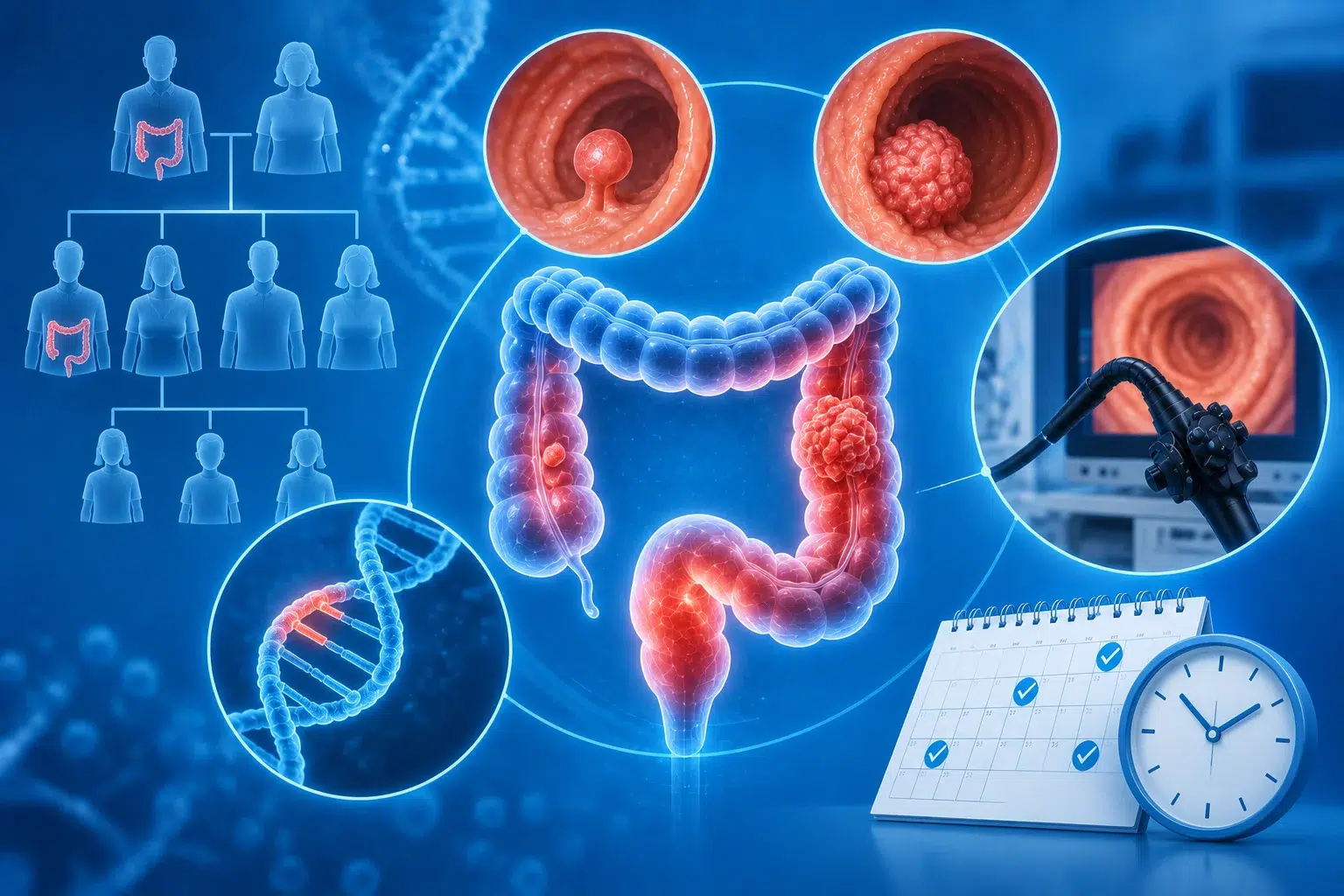
Knowing your family history is the cheapest prevention tool there is: it decides when you start, which test you use and how often you repeat it.
The short version
Familial colon cancer
- One first-degree relative diagnosed at 60 or older: only slightly higher risk. Standard screening, which some guidelines bring forward to 40.
- One relative before 50-60, or two relatives: colonoscopy at 40, or 10 years before the youngest case, then every 5 years.
- Uncles, grandparents or cousins on their own rarely change the starting age.
Hereditary syndromes
- Lynch syndrome: colonoscopy from 25 or 35 depending on the gene, every 2-3 years.
- Familial adenomatous polyposis (FAP): from age 12, with preventive surgery in most cases.
- MUTYH-associated polyposis: from 18, every 1-2 years.
Do you have symptoms? Then this is no longer screening, and you should not wait for any age. See the red flags.
Before you read on
This article summarizes clinical guidelines so you can understand your situation. Your own plan depends on details of your family that can only be assessed in a consultation.
A family history of colon cancer is one of the most common, and most justified, reasons to start screening earlier. The good news is that it usually translates into something simple: start sooner and repeat the tests more often. The bad news is that most relatives never get tested, and the guidelines do not always agree, so it is worth understanding which group you are in.
How much does a relative with colon cancer raise your risk?
Less than many people fear, but enough to change the plan. The most comprehensive meta-analysis, covering 62 studies, found that having one first-degree relative with colon cancer multiplies the risk by between 1.4 and 1.9. With two or more relatives, by between 2.4 and 2.8. And if the relative was diagnosed before 50, by more than 3.1
In real terms, in Western Europe, the cumulative chance of developing colon cancer by age 85 is:
Put another way: even with an affected parent, more than 95 in every 100 people will never develop colon cancer. A family history is not a sentence, it is a signal to start earlier. And that signal is very often missed: in a trial across 12 Spanish hospitals, only about a third of the first-degree relatives invited actually had a test, whether colonoscopy or stool test.12
On top of that, colon cancer is rising in people under 50, which I explain in why colon cancer is increasing in young adults.
Who counts as a family history, and who doesn't
Guidelines are almost always based on first-degree relatives: father, mother, siblings and children. They share half of your genes.24
- Counts a lot: the number of affected first-degree relatives and their age at diagnosis. The younger and the more numerous, the higher the risk.
- Also counts: an advanced polyp in a first-degree relative before 60, according to the US guideline.5 If you are not sure what an advanced polyp is, I explain it in what risk does a polyp have of becoming cancer.
- Counts little on its own: uncles, grandparents or cousins, who are second- or third-degree relatives. They only change the plan when there are many cases in the family or very young cases, because then a hereditary syndrome must be considered.
A practical tip: ask your family exactly what type of cancer it was and at what age. "Bowel cancer" at 80 and "colon cancer" at 42 lead to completely different plans. It also matters whether anyone has had cancer of the endometrium, ovary, stomach or urinary tract, because these are part of Lynch syndrome.
Summary table: when to start and how often
| Your situation | Test | From | How often |
|---|---|---|---|
| No affected first-degree relatives | Stool test for hidden blood | 50 (Spanish program) | 2 years |
| 1 first-degree relative diagnosed at 60 or older | Stool test or colonoscopy | 40-50 depending on guideline | As for the general population |
| 1 first-degree relative before 60, or 2 or more at any age | Colonoscopy | 40, or 10 years before the youngest case | 5 years if normal |
| Lynch syndrome, MLH1 and MSH2 genes | High-definition colonoscopy | 25 | 2-3 years |
| Lynch syndrome, MSH6 gene | High-definition colonoscopy | 35 | 2-3 years |
| Lynch syndrome, PMS2 gene | High-definition colonoscopy | 35 | Every 5 years may be considered |
| Classic familial adenomatous polyposis | Colonoscopy or sigmoidoscopy | 12 | Yearly, until surgery |
| Attenuated FAP | Colonoscopy | No later than 18-20 | 1-2 years |
| MUTYH-associated polyposis | Colonoscopy, plus gastroscopy from 35 | 18 | 1-2 years |
Synthesis of the European, Spanish, British and US guidelines cited below. Where they disagree, I explain it in the text.
Familial colon cancer, without a hereditary syndrome
This is by far the most common situation: there are one or more cases in the family, but no mutation has been found. Here the guidelines agree on the essentials and disagree on the details, and it helps to know both.
What the guidelines say
- European Society of Gastrointestinal Endoscopy (ESGE). Defines familial risk as two or more first-degree relatives with colon cancer, or one diagnosed before 50, and recommends colonoscopy surveillance in that case.2
- Spanish guideline. With a single first-degree relative, once a hereditary syndrome has been ruled out, it recommends joining the population screening program, with the stool test as a valid alternative to colonoscopy. With two or more relatives, colonoscopy every 5 years.6
- US guideline. With a first-degree relative with cancer or an advanced polyp before 60, or two relatives at any age: colonoscopy every 5 years from 40, or 10 years before the youngest case. With a single relative at 60 or older: standard screening, but starting at 40.5
- British guideline. The most conservative: for moderate risk it proposes a single colonoscopy at 55, and colonoscopy every 5 years between 40 and 75 only when there are three or more first-degree relatives across at least two generations.4
Why such differences? Because the latest meta-analysis found the increase in risk is smaller than previously thought, especially in cohort studies, and each country weighs the benefit against the cost and burden of colonoscopies differently.1 The British guideline itself acknowledges that, with colon cancer rising in young people, its starting age may need revisiting.4
Colonoscopy or stool test?
Spanish evidence is particularly relevant here. In a trial of first-degree relatives, three yearly stool tests detected every cancer and were equivalent to one colonoscopy for advanced lesions, needing four times fewer colonoscopies to find each one. They did, however, miss 16 of 41 advanced adenomas.11 A second Spanish trial, published in 2023, found instead that colonoscopy detected more advanced lesions, and that offering the stool test did not get more relatives tested.12 In average-risk people, the large Spanish COLONPREV trial showed in 2025 that inviting people to a stool test is not inferior to inviting them to colonoscopy for colon cancer deaths at ten years.13
My practical reading: with two or more relatives, or a young relative, colonoscopy. With a single relative diagnosed at an older age, the stool test is a reasonable option, and the worst option is doing neither. I compare them in detail in colonoscopy vs fecal occult blood test, and I review the new blood tests in colon cancer screening with a blood test.
If your colonoscopy is normal
With familial risk, the next one is due in 5 years. If polyps are found, the interval is set by those polyps, as I explain in after-polypectomy recommendations. And the quality of the procedure matters as much as how often it is done: see why a quality colonoscopy matters.
Lynch syndrome
This is the most common hereditary colon cancer syndrome. It is caused by a mutation in one of the genes that repair DNA errors, called MLH1, MSH2, MSH6 and PMS2, and it also raises the risk of cancer of the endometrium, ovary, stomach, small bowel and urinary tract.
The risk depends on the gene
The largest European registry, following more than 6,300 carriers prospectively, showed that MLH1 and MSH2 carry the highest risk, with a lifetime colon cancer risk close to 50% despite surveillance. MSH6 raises the risk more moderately, and no significant increase was shown for PMS2. The reassuring part: cancers found within surveillance had a very good prognosis, with 95% five-year survival for colon cancer.9
When to start and how often
- MLH1 and MSH2: colonoscopy from age 25.27
- MSH6 and PMS2: from age 35.27
- Interval: every 2 or 3 years for MLH1, MSH2 and MSH6, and every 2 years after a previous colon cancer. For PMS2, every 5 years may be considered.7 The 2018 Spanish guideline suggested starting at 20-25 with yearly or two-yearly colonoscopy; later European guidelines have refined that schedule by gene.6
- How: with high-definition colonoscopy, in experienced units. Chromoendoscopy may add something, although it is not essential routinely.2 If you are interested, I explain the technique in chromoendoscopy.
Aspirin, an evidence-based aid
In the CAPP2 trial, 861 people with Lynch syndrome received aspirin or placebo for two to four years. After ten years of follow-up, colon cancer developed in 9% of the aspirin group versus 13% of the placebo group.10 European guidelines recommend discussing it with all carriers, at a minimum dose of 75-100 mg daily.7 It should never be started on your own, because its bleeding risk needs to be weighed individually.
Familial adenomatous polyposis and MUTYH-associated polyposis
These are much rarer than Lynch syndrome, but the risk is very high without surveillance. The European guidelines were updated in 2024.8
Familial adenomatous polyposis (FAP)
- Classic: surveillance from age 12 in carriers of an APC gene mutation, or in first-degree relatives of affected people when genetic testing is not conclusive, and at any age if there are symptoms. Most will eventually need preventive colon surgery, timed according to the number and type of polyps.8
- Attenuated: surveillance can start later, but no later than 18-20.8
- Stomach and duodenum: gastroscopy from 18 and no later than 30, because the duodenum is the next site at risk.8 I discuss the stomach polyps seen in these families in gastric polyps.
MUTYH-associated polyposis
Unlike FAP and Lynch syndrome, it is inherited recessively: two altered copies are needed, one from each parent, which is why there are often no cases in previous generations. Colonoscopy surveillance starts at 18 and is repeated every 1-2 years depending on the number of polyps, with gastroscopy from 35.8
Other polyposis syndromes
Serrated polyposis, Peutz-Jeghers syndrome and juvenile polyposis have their own surveillance programs. What matters is that all these patients are followed in specialized units that monitor the quality of each procedure.3 When polyps are large or complex, removing them endoscopically is exactly what we do in our complex polyp unit.
When to suspect a hereditary syndrome and ask for genetic testing
The Spanish guideline stresses that, before deciding on a plan, it has to be ruled out that the family clustering is a hereditary syndrome.6 Suspect one if your family has:
- Colon cancer before 50.
- Several relatives affected across successive generations.
- Colon and endometrial, ovarian, stomach or urinary tract cancers on the same side of the family.
- 10 or more polyps in total in one person.4
- One person with several different cancers.
The most efficient route usually starts with the affected relative's tumor. The Spanish guideline recommends routinely testing every colon cancer for Lynch syndrome, with immunohistochemistry or microsatellite instability, and using gene panels in people with polyposis.6 If a mutation is confirmed, the rest of the family can have a targeted test. Those who have not inherited it go back to average risk, which saves years of unnecessary colonoscopies.
Six myths about family history
Red flags: don't wait for screening age
Everything above is for people without symptoms. If you have any of these, it needs investigating now, whatever your age:
- Blood in the stool or black stools. I explain it in blood in stool.
- A persistent change in bowel habit lasting more than a few weeks.
- Anemia or iron deficiency without a clear cause.
- Unintentional weight loss.
- Persistent abdominal pain or a feeling of incomplete emptying.
How I approach it in clinic
The first step is drawing the family tree: who, what type of cancer and at what age. In most cases that tells us within ten minutes which group you are in. If there are signs of a hereditary syndrome, the next step is testing the relative's tumor or genetic counseling.
Where the guidelines disagree, as with a single relative, I talk it through with each person: their age, their polyp history and how they feel about each option. And when colonoscopy is indicated, I make sure it is a quality one, with good preparation and in the best conditions. You can prepare for yours with our interactive prep app, read 10 things to know before a colonoscopy, or see how we work in private colonoscopy in Madrid.
Family history and not sure when to start?
We review your family history and tell you which test is right for you and when. In Madrid or by video consultation.
Book an AppointmentRelated reading


In high-risk families, the quality of each colonoscopy matters as much as how often it is done.
Frequently asked questions
My father had colon cancer. At what age should I start screening?
It depends mainly on how old he was when diagnosed and whether other relatives are affected. If your father or mother was diagnosed before 60, or two first-degree relatives are affected, the usual advice is a colonoscopy at 40, or 10 years before the youngest relative's age at diagnosis if that is earlier. If a single relative was diagnosed at 60 or older, your risk is only slightly higher than average and the Spanish guideline recommends joining the population screening program with a stool test, although other guidelines, such as the US one, suggest starting at 40.
How often do I need a colonoscopy if I have a family history of colon cancer?
For familial colon cancer without a hereditary syndrome, every 5 years if the colonoscopy is normal, and sooner if polyps are found. In Lynch syndrome the interval shortens to every 2 or 3 years depending on the gene. In familial adenomatous polyposis and MUTYH-associated polyposis, every 1 or 2 years. Having one every year without a syndrome that justifies it adds no protection and does add risk.
Is a stool test good enough if a relative had colon cancer?
With a single first-degree relative diagnosed at an older age, it is an accepted option. A Spanish trial showed that three yearly stool tests detected every cancer and were as effective overall as colonoscopy for advanced lesions. With two or more relatives, or a relative diagnosed young, colonoscopy is the recommended test. In hereditary syndromes a stool test is not a substitute.
When should I have genetic testing?
When the family history suggests a hereditary syndrome: colon cancer before 50, several relatives affected across successive generations, colon and endometrial cancers in the same family, or 10 or more polyps in total. The most useful first step is usually testing the tumor of the affected relative, which in Spain should be analyzed routinely to rule out Lynch syndrome. If a mutation is confirmed in the family, other relatives can have a targeted test and, if they do not carry it, they go back to average risk.
References
- Roos VH, et al. Effects of Family History on Relative and Absolute Risks for Colorectal Cancer: A Systematic Review and Meta-Analysis. Clin Gastroenterol Hepatol. 2019;17(13):2657-2667.e9. PubMed (opens in a new tab)
- van Leerdam ME, et al. Endoscopic management of Lynch syndrome and of familial risk of colorectal cancer: European Society of Gastrointestinal Endoscopy (ESGE) Guideline. Endoscopy. 2019;51(11):1082-1093. PubMed (opens in a new tab)
- van Leerdam ME, et al. Endoscopic management of polyposis syndromes: European Society of Gastrointestinal Endoscopy (ESGE) Guideline. Endoscopy. 2019;51(9):877-895. PubMed (opens in a new tab)
- Monahan KJ, et al. Guidelines for the management of hereditary colorectal cancer from the British Society of Gastroenterology (BSG)/Association of Coloproctology of Great Britain and Ireland (ACPGBI)/United Kingdom Cancer Genetics Group (UKCGG). Gut. 2020;69(3):411-444. PubMed (opens in a new tab)
- Rex DK, et al. Colorectal Cancer Screening: Recommendations for Physicians and Patients from the U.S. Multi-Society Task Force on Colorectal Cancer. Am J Gastroenterol. 2017;112(7):1016-1030. PubMed (opens in a new tab)
- Cubiella J, et al. Clinical practice guideline. Diagnosis and prevention of colorectal cancer. 2018 Update. Gastroenterol Hepatol. 2018;41(9):585-596. PubMed (opens in a new tab)
- Seppälä TT, et al. European guidelines from the EHTG and ESCP for Lynch syndrome: an updated third edition of the Mallorca guidelines based on gene and gender. Br J Surg. 2021;108(5):484-498. PubMed (opens in a new tab)
- Zaffaroni G, et al. Updated European guidelines for clinical management of familial adenomatous polyposis (FAP), MUTYH-associated polyposis (MAP), gastric adenocarcinoma, proximal polyposis of the stomach (GAPPS) and other rare adenomatous polyposis syndromes: a joint EHTG-ESCP revision. Br J Surg. 2024;111(5). PubMed (opens in a new tab)
- Dominguez-Valentin M, et al. Cancer risks by gene, age, and gender in 6350 carriers of pathogenic mismatch repair variants: findings from the Prospective Lynch Syndrome Database. Genet Med. 2020;22(1):15-25. PubMed (opens in a new tab)
- Burn J, et al. Cancer prevention with aspirin in hereditary colorectal cancer (Lynch syndrome), 10-year follow-up and registry-based 20-year data in the CAPP2 study: a double-blind, randomised, placebo-controlled trial. Lancet. 2020;395(10240):1855-1863. PubMed (opens in a new tab)
- Quintero E, et al. Equivalency of fecal immunochemical tests and colonoscopy in familial colorectal cancer screening. Gastroenterology. 2014;147(5):1021-30.e1; quiz e16-7. PubMed (opens in a new tab)
- González-López N, et al. Screening uptake of colonoscopy versus fecal immunochemical testing in first-degree relatives of patients with non-syndromic colorectal cancer: A multicenter, open-label, parallel-group, randomized trial (ParCoFit study). PLoS Med. 2023;20(10):e1004298. PubMed (opens in a new tab)
- Castells A, et al. Effect of invitation to colonoscopy versus faecal immunochemical test screening on colorectal cancer mortality (COLONPREV): a pragmatic, randomised, controlled, non-inferiority trial. Lancet. 2025;405(10486):1231-1239. PubMed (opens in a new tab)
Your family history sets your schedule
We help you find out which group you are in, which test is right for you and how often to repeat it.
Book an Appointment
Transparency: this article is not sponsored and promotes no brand or product. All sources are listed and linked above.