
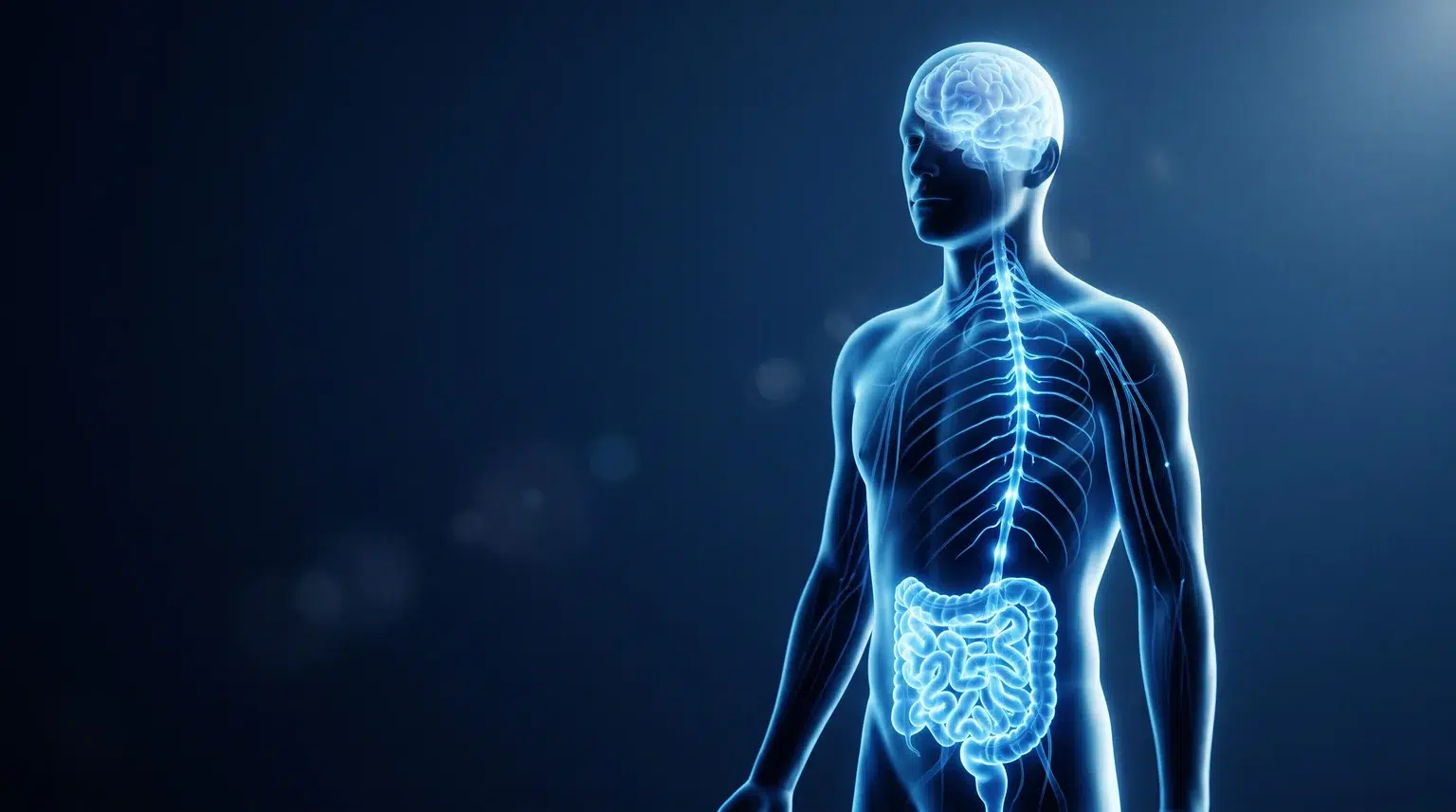
Centrally mediated abdominal pain is abdominal pain that lasts for months, does not change with what you eat or when you go to the toilet, and does not respond to the usual painkillers. Tests come back normal and many patients end up feeling that nobody believes them. It has a name and a treatment, and knowing about it can save years of repeated tests.
What centrally mediated abdominal pain is
Centrally mediated abdominal pain syndrome is chronic abdominal pain, continuous or nearly continuous, that barely changes with meals or bowel movements and ends up limiting daily life. Until 2016 it was called functional abdominal pain syndrome. The Rome IV criteria renamed it to make clear that its main source lies in how the nervous system processes pain.3
The Rome V criteria, published in 2026, replace Rome IV. They revise the definitions of the disorders of gut-brain interaction and avoid imprecise or stigmatizing terms.1 The syndrome keeps its name within the centrally mediated disorders of gastrointestinal pain, alongside narcotic bowel syndrome and abdominal migraine, which Rome V now also recognizes in adults. It describes two categories: in category A the pain has no link to meals, bowel movements or other physiological events, and in category B that link exists but varies.2
It is uncommon. It is estimated to affect between 0.5% and 2.1% of the population, more women than men.4 Disorders of gut-brain interaction as a whole are very common: in the worldwide survey using the Rome V criteria, 40.9% of adults met the criteria for at least one.16
What sets it apart from similar conditions is how the pain relates to the body. In irritable bowel syndrome, pain is related to bowel movements and to changes in stool frequency or form. In functional dyspepsia, symptoms sit in the upper abdomen and are usually tied to meals. In centrally mediated abdominal pain, the pain stays whether you eat or go to the toilet.35 If the pain comes in intense, repeated attacks that look alike and disappears in between, Rome V classifies it as abdominal migraine.2
Why it hurts when the tests are normal
According to Rome V, the main mechanism is central sensitization: the spinal cord and the brain process signals from the gut in an altered way. That amplification matters more than any extra excitability of the nerves in the gut itself.2 Rome IV described it as a loss of the brakes the nervous system puts on pain signals.3 Those brakes are pathways running down from the brain to the spinal cord that regulate how much pain is felt, and they can fail too.5
That is why an ultrasound, blood tests or a colonoscopy can come back normal while the pain is very real. It is the same gut-brain axis involved in other digestive disorders, with even more weight on the nervous system side.
Mood influences that processing. In a study of 73 patients, depression and lack of exercise were associated with the syndrome, and anxiety with more severe pain.6 That does not make the pain psychological or made up: one of the diagnostic criteria is, precisely, that the pain is not feigned.4
Myth or fact? Test what you know
Pick an answer for each statement and see what the evidence says.
1. “If all the tests are normal, the pain is imaginary.”
Myth. The pain comes from central sensitization: the spinal cord and brain process gut signals in an altered way. That is why tests can be normal while the pain is real.23
2. “Opioid painkillers can increase abdominal pain over time.”
Fact. This is narcotic bowel syndrome: pain appears or increases with continuous or rising doses of opioids, and improves when they are withdrawn.29
3. “Every time the pain flares, the tests should be repeated.”
Myth. Without warning signs, an extensive work-up is not needed. Ruling out organic disease once, with the right tests, is enough.45
4. “A low-dose antidepressant can ease the pain even if you are not depressed.”
Fact. The Rome Foundation considers low-dose tricyclics to have the most convincing evidence in chronic gut pain. They are used for their effect on pain.10
5. “Some chronic abdominal pain comes from the abdominal wall.”
Fact. Between 10% and 30% of patients with chronic abdominal pain end up with this diagnosis, which is suspected with Carnett's sign.7
0 of 6 answered
How it is diagnosed
The Rome IV criteria require all of the following for the last 3 months, with onset at least 6 months before diagnosis:4
- Continuous or nearly continuous abdominal pain.
- No relationship, or only an occasional one, with physiological events such as eating, bowel movements or menstruation.
- The pain limits some aspect of daily life: work, intimacy, leisure, family, or caring for yourself and others.
- The pain is not feigned.
- No other structural or functional digestive disorder, or other medical condition, explains it.
Rome V has updated this definition with the A and B categories described above.2 In clinic I still use these five points as a practical guide.
The diagnosis rests on the symptoms and a long history of pain. Without warning signs, an extensive work-up is not needed.5 The sensible approach is to do just the tests needed to rule out organic disease: basic blood tests with inflammatory markers and thyroid function. If there is weight loss, anemia or bleeding, ultrasound, CT or endoscopy are added.4 Repeating tests that were already normal rarely adds new information and exposes you to needless risks.15
One diagnosis is worth not missing: abdominal wall pain. According to various estimates, 10% to 30% of patients with chronic abdominal pain end up with this diagnosis, often after many expensive tests. It is suspected with Carnett's sign, a simple examination maneuver: the tender spot hurts the same or more when the patient tenses the abdominal muscles.7 If you are unsure about where your pain is, the interactive guide to abdominal pain by location can help, and in chronic abdominal pain I explain how I assess it.
When painkillers make the pain worse: narcotic bowel syndrome
Narcotic bowel syndrome, also called opioid-induced gastrointestinal hyperalgesia, is abdominal pain that appears or increases while taking opioids continuously or at rising doses. Rome V places it in the same group as centrally mediated abdominal pain.2 It is rarely diagnosed and is probably under-recognized. The main mechanism seems to be hyperalgesia: with sustained use, the opioid itself makes the pain system more sensitive.8
Treatment means explaining to the patient why the drug is harming them and withdrawing it gradually, with antidepressants, anxiolytics and psychological support along the way.8 In a series of 39 patients at the University of North Carolina, 89.7% completed withdrawal and abdominal pain fell by 35%. At 3 months, 45.8% had gone back on opioids. Those who stayed off them had pain 75% lower than at the start, against 24% for those who resumed them.9
Treatments backed by evidence
Treatment starts with the relationship between doctor and patient. Rome V stresses its importance at every stage of care.2 A Rome Foundation review concluded that good communication improves the relationship with the patient, their satisfaction and clinical outcomes, although the data are still limited.14 In practice, that means giving the pain a name, explaining how it works and setting realistic goals, such as getting back to activities, without promising the pain will vanish completely.15
The drugs that work best are central neuromodulators, medicines that act on how pain is processed. Many of them are antidepressants, but here they are used at low doses for pain. The Rome Foundation concluded that low to moderate doses of tricyclic antidepressants, such as amitriptyline, have the most convincing evidence in chronic gut pain. Serotonin and noradrenaline reuptake inhibitors, such as duloxetine, are also recommended, although more studies are needed. If one drug is not enough, a second can be added, and treatment should continue for 6 to 12 months to reduce relapse.10 Trials specific to this syndrome are scarce and much of the evidence comes from irritable bowel syndrome, where antidepressants reduced the risk of still having symptoms by 34% compared with placebo.1011
Pregabalin is another option. In an open-label trial of 102 patients with this syndrome, it eased pain more than pinaverium at 2 and 4 weeks and reduced anxiety more.13 Because the trial was not blinded, the result should be read with caution.
Psychological therapies aimed at the gut-brain axis also ease pain. In a meta-analysis of 42 trials with 5,220 patients with irritable bowel syndrome, cognitive behavioral therapy, multicomponent behavioral therapy and gut-directed hypnotherapy improved abdominal pain, with none better than the others.12 Rome III already recommended psychotherapy, relaxation techniques and hypnosis, and a multidisciplinary pain clinic for the hardest cases.5
| Option | What to expect | Strength |
|---|---|---|
| Low-dose tricyclic antidepressant (amitriptyline) | The most convincing evidence for chronic gut pain | Rome recommendation, few trials in this syndrome |
| Duloxetine and similar drugs | Recommended alternative, especially if a tricyclic is not tolerated | Rome recommendation, more studies needed |
| Cognitive behavioral therapy or hypnotherapy | Less abdominal pain | Meta-analysis in irritable bowel syndrome |
| Pregabalin | Less pain at 4 weeks | One open-label trial |
| A good doctor-patient relationship | Better satisfaction and better outcomes | Rome review, limited data |
| Opioids | Can increase pain; best avoided | Patient series |
Green clinical trial or guideline · Amber studies with mixed results · Red association or weak evidence
If you also have abdominal bloating or gas, these are treated separately, because they respond to different measures.
Signs that call for another explanation
Centrally mediated abdominal pain does not explain these symptoms. If you have any of them, get checked:
Tick any you have:
Centrally mediated abdominal pain does not cause weight loss by itself. In clinic, though, I often see patients who lose weight because they have cut out more and more foods for fear of pain and end up on very restrictive diets. Even so, any weight loss should be assessed before putting it down to diet.
How I approach it in clinic

“Once the tests have ruled out organic disease, it is time to stop searching and start treating the pain, which is real.”
Dr. Pedro de María Pallarés
Many patients arrive after years of normal tests, feeling that nobody believes them. I start by listening to the whole story and reviewing what has already been done. I examine the abdomen carefully, including Carnett's sign, and only order what is genuinely missing or what a warning sign justifies. Then I explain central sensitization, because understanding why it hurts already brings some relief. We agree on concrete goals, such as getting back to work or exercise. If it fits, I suggest a low-dose neuromodulator, explaining that we use it for pain, and a referral for psychological therapy. If opioids are involved, we plan together how to taper them. Follow-up visits are booked in advance rather than waiting for the pain to get worse.
Months of pain that will not ease?
We assess it without repeating what has already been done and look for the treatment that suits you. In Madrid or by video consultation.
Book an AppointmentDid you find this useful?
If someone you know lives with abdominal pain that will not go away, this may help:
WhatsApp XRelated reading


A careful examination helps avoid repeating tests that have already been done.
Frequently asked questions
What is centrally mediated abdominal pain?
It is chronic abdominal pain, continuous or nearly continuous, that barely changes with meals or bowel movements and limits daily life. It is mainly due to central sensitization: the nervous system amplifies the signals coming from the gut. It used to be called functional abdominal pain syndrome.
Is it the same as irritable bowel syndrome?
No. In irritable bowel syndrome the pain is related to bowel movements and changes in stools. In centrally mediated abdominal pain the pain stays whether you eat or go to the toilet, and the central nervous system plays a larger role.
Why am I prescribed an antidepressant if I am not depressed?
Because at low doses these drugs act on how pain is processed. The Rome Foundation considers low-dose tricyclics to have the most convincing evidence in chronic gut pain, and recommends continuing them for 6 to 12 months.
Do I need to keep having tests?
If organic disease has already been ruled out and there are no warning signs, no. Repeating normal tests adds no information. It is worth checking whether the pain comes from the abdominal wall, and reassessing if a warning sign appears.
Do opioids help with this pain?
They are best avoided. With continued use they can cause narcotic bowel syndrome, in which abdominal pain increases. In a series of 39 patients, tapering them off reduced abdominal pain by 35%.
References (16 studies · tap to view)
- Drossman DA, et al. Disorders of Gut-Brain Interaction and the Rome V Process. Gastroenterology. 2026;170(6):1083-1098. PubMed (opens in a new tab)
- Fukudo S, et al. Centrally Mediated Disorders of Gastrointestinal Pain. Gastroenterology. 2026;170(6):1283-1302. PubMed (opens in a new tab)
- Keefer L, et al. Centrally Mediated Disorders of Gastrointestinal Pain. Gastroenterology. 2016;. PubMed (opens in a new tab)
- Kim HJ, et al. [Centrally Mediated Abdominal Pain Syndrome]. Korean J Gastroenterol. 2021;77(6):277-284. PubMed (opens in a new tab)
- Clouse RE, et al. Functional abdominal pain syndrome. Gastroenterology. 2006;130(5):1492-7. PubMed (opens in a new tab)
- Yuming T, et al. The Clinical Characteristics and Related Factors of Centrally Mediated Abdominal Pain Syndrome. Clin Transl Gastroenterol. 2023;14(11):e00624. PubMed (opens in a new tab)
- Glissen Brown JR, et al. Chronic Abdominal Wall Pain: An Under-Recognized Diagnosis Leading to Unnecessary Testing. J Clin Gastroenterol. 2016;50(10):828-835. PubMed (opens in a new tab)
- Farmer AD, et al. Narcotic bowel syndrome. Lancet Gastroenterol Hepatol. 2017;2(5):361-368. PubMed (opens in a new tab)
- Drossman DA, et al. Diagnosis, characterization, and 3-month outcome after detoxification of 39 patients with narcotic bowel syndrome. Am J Gastroenterol. 2012;107(9):1426-40. PubMed (opens in a new tab)
- Drossman DA, et al. Neuromodulators for Functional Gastrointestinal Disorders (Disorders of Gut-Brain Interaction): A Rome Foundation Working Team Report. Gastroenterology. 2018;154(4):1140-1171.e1. PubMed (opens in a new tab)
- Ford AC, et al. Effect of Antidepressants and Psychological Therapies in Irritable Bowel Syndrome: An Updated Systematic Review and Meta-Analysis. Am J Gastroenterol. 2019;114(1):21-39. PubMed (opens in a new tab)
- Goodoory VC, et al. Effect of Brain-Gut Behavioral Treatments on Abdominal Pain in Irritable Bowel Syndrome: Systematic Review and Network Meta-Analysis. Gastroenterology. 2024;167(5):934-943.e5. PubMed (opens in a new tab)
- Xu R, et al. Randomized clinical trial: the effects of pregabalin for centrally mediated abdominal pain syndrome. Ther Adv Gastroenterol. 2023;16:17562848231152334. PubMed (opens in a new tab)
- Drossman DA, et al. A Review of the Evidence and Recommendations on Communication Skills and the Patient-Provider Relationship: A Rome Foundation Working Team Report. Gastroenterology. 2021;161(5):1670-1688.e7. PubMed (opens in a new tab)
- Paine P. Chronic Abdominal Pain: Practical Approaches. Br J Hosp Med (Lond). 2025;86(10):1-15. PubMed (opens in a new tab)
- Sperber AD, et al. Rome V global epidemiology and validation survey: prevalence of disorders of gut-brain interaction and comparison with the Rome IV global epidemiology study. Gut. 2026;75(10):1887-1897. PubMed (opens in a new tab)