
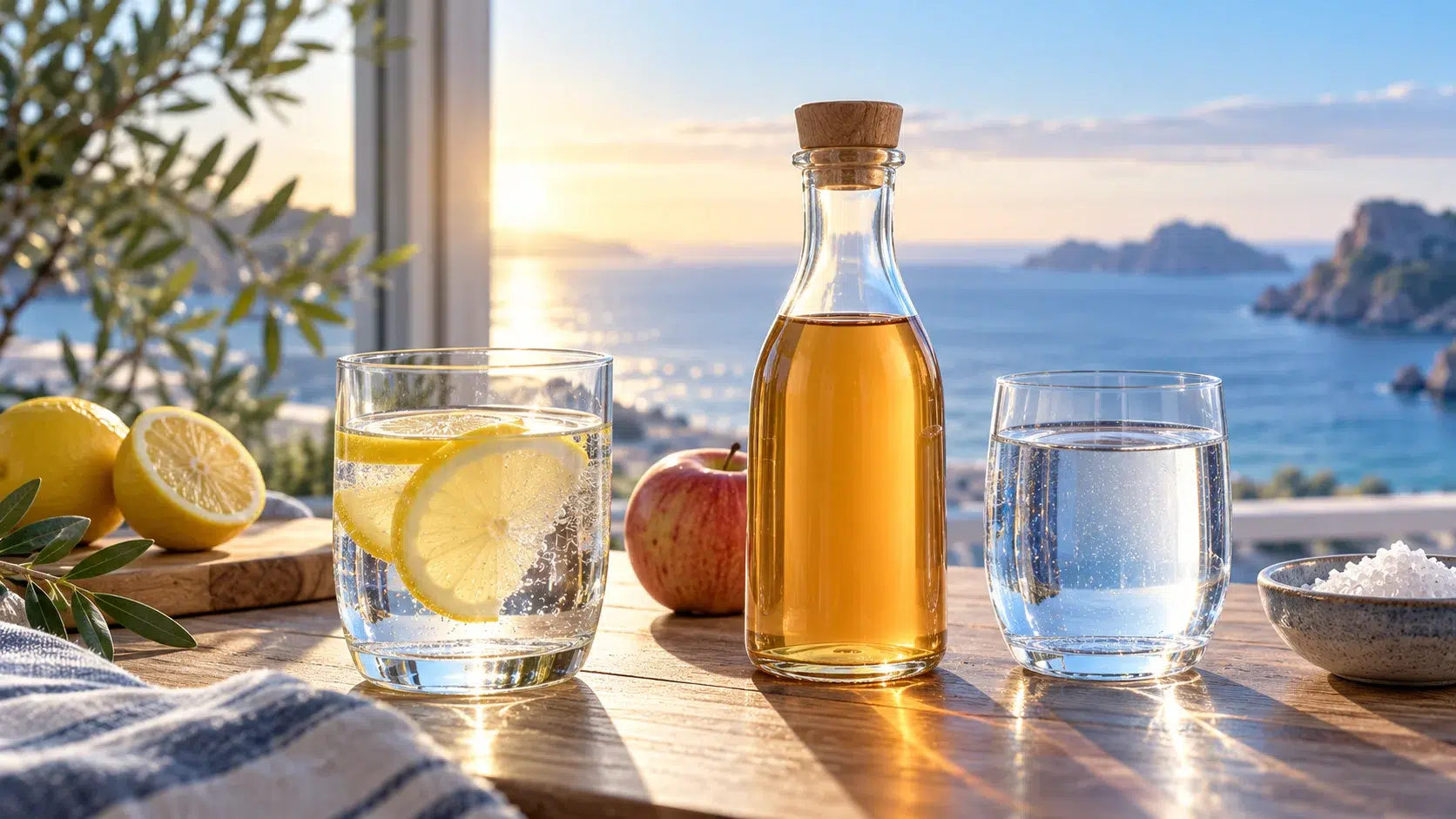
Apple cider vinegar, lemon water and sea water are the three empty-stomach rituals I see most on social media and get asked about most in clinic. They are credited with everything: weight loss, liver detox, alkalizing the body or fixing digestion. The studies offer far less. Vinegar has a small effect on blood sugar, and the salt in sea water is not right for everyone.
Apple cider vinegar on an empty stomach: a small, real effect on blood sugar
Of the three rituals, vinegar is the one with the most studies behind it. A 2026 review pooled 10 meta-analyses covering 38 studies and found that vinegar lowered blood glucose after meals by an average of 14.6 mg/dL, fasting glucose by 9.4 mg/dL and glycated hemoglobin by 0.7%, with moderate certainty. Body weight fell by an average of 1.06 kg, and for that figure the certainty was high.1
Another meta-analysis, from 2025, looked only at apple cider vinegar: 10 trials with 789 participants. Weight, body mass index and waist circumference went down a little, but other measures of body composition did not change. The effect was seen mainly with 30 ml a day, for up to 12 weeks, in adults with overweight, obesity or type 2 diabetes.2 One kilo in three months is fine, but it is far from what many videos promise.
There is one detail worth knowing. A 2024 trial in Lebanese adolescents and young adults with overweight, which credited apple cider vinegar with reductions in weight, waist and body fat and no side effects, was retracted by the journal in 2025.3 If you see that study quoted as proof, it no longer counts.
What it does in the stomach
Vinegar makes the stomach empty more slowly, and part of its effect on blood sugar comes from that. In people with type 1 diabetes and gastroparesis, the stomach already empties slowly. In a trial of 10 such patients, taking 30 ml of apple cider vinegar in 200 ml of water before breakfast for two weeks slowed emptying even further: the median went from 27% to 17%. The authors warn that this may worsen glucose control.4 If you inject insulin, food leaving the stomach at a different pace can put the dose out of step with the rise in blood sugar.
For indigestion, bloating or reflux there is no evidence in its favor. A review of the best-selling reflux products on Amazon found strong evidence only for weight loss and acid-reducing medicines, and rated the evidence for apple cider vinegar as insufficient.5 In clinic I often see the opposite of what is promised: people with esophagitis or gastritis who get more heartburn from a swig of acid on an empty stomach. If that is you, these heartburn tips have better support.
The possible harms
- Teeth. On extracted human teeth, vinegar and apple cider removed the most mineral from enamel and dentine, and lemon juice also caused marked changes. The authors advise cutting down how often and how long the drink touches the teeth, and rinsing afterwards.6
- Esophagus. After a case of esophageal injury from apple cider vinegar tablets, eight brands were tested: they varied widely in size, acidity and content, and for some it was unclear whether they contained apple cider vinegar at all.7 Drinking it neat, in gulps, makes no sense either.
- Potassium and bones. One person who drank large amounts of cider vinegar developed low potassium, hormonal changes and osteoporosis.8 It is a single case, but if you take diuretics, which also lower potassium, check first.
If you still want to take it, the sensible way is to dilute it in a large glass of water, not go beyond what the trials used, around 30 ml a day,24 and rinse your mouth with water afterwards.6
Lemon water in the morning: it hydrates, but it does not detox or alkalize
A glass of warm water with half a lemon in the morning is a pleasant habit and generally harmless. The trouble lies in what it is credited with.
The idea that it detoxes the liver does not hold up. Clearing substances from the body is the job of the liver and kidneys around the clock, and no drink does that work for them. A critical review of detox diets concluded that there is very little clinical evidence, that the few studies have flawed methods and small samples, and that no randomized trial of commercial detox diets has been done in people.9 If you are worried about your liver, what actually protects it is in these fatty liver tips. And be careful with herbal detox products, which are not always harmless, as I explain in the article on herbs that can harm the liver.
Nor does it alkalize the body. Lemon juice is acidic. In a healthy person, the lungs and kidneys keep blood pH within a very narrow range, and what you drink does not shift it. A systematic review of the alkaline diet and alkaline water found almost no studies either for or against, and concluded that promoting them to the public is not justified.10
The real drawback is your teeth: lemon juice also demineralizes enamel.6 Sipping it slowly every morning for years is the worst way to take it. If you have reflux and notice that citrus gives you heartburn, there is no need to keep drinking it.
Sea water on an empty stomach: hypertonic, isotonic and Quinton-type
Sea water sold for drinking is collected at sea, microfiltered and bottled. The so-called hypertonic version is plain sea water, more concentrated than blood. The isotonic version is diluted with fresh water until it matches the concentration of plasma. Quinton-type brands present it as a mineral supplement, and on social media it is recommended on an empty stomach to detox, remineralize or improve digestion.
What the trials say
I found few trials in people, all of them small. In one, 15 male triathletes completed three triathlons drinking commercial Quinton-type sea water, tap water or saline as a placebo. Sea water did not improve performance; two substances released by muscle during exercise, interleukin 6 and apelin, went up.11 In another, 93 women aged around 70 did 32 weeks of exercise with elastic bands, with microfiltered sea water or a placebo. Systolic blood pressure fell in both exercise groups, whether or not they drank sea water; diastolic pressure fell in both sea water groups, and the authors considered it safe in that group of women.12
Neither trial measured anything digestive. I found no trials showing that sea water on an empty stomach improves digestion, bowel habit or bloating.
The problem is the salt
A 2025 systematic review analyzed 22 studies on drinking water with more than 200 mg of sodium per liter. With moderate-quality evidence, it linked that water to high blood pressure and cardiovascular disease, poorer kidney function, high blood pressure in pregnancy and preeclampsia.13 Sea water, even diluted to make it isotonic, carries far more salt than that. So I do not recommend it if you have high blood pressure, heart failure or kidney disease, if you are pregnant, or if your doctor has told you to eat less salt.
Hypertonic sea water has another effect. A solution more concentrated than blood draws water into the gut, the same principle some laxatives use. The result can be osmotic diarrhea, with cramps and abdominal bloating, which some people take as a sign that the body is cleansing itself.
And do not collect it straight from the beach. Vibrio bacteria live in the sea and cause infections through contact with sea water or from eating raw seafood. The most common result is a mild gastroenteritis, but Vibrio vulnificus can cause serious infections.14 On top of that come the sewage and pollution of each stretch of coast.
Myth or fact? Test what you know
Pick an answer for each statement and see what the evidence says.
1. “Lemon water on an empty stomach detoxes the liver.”
Myth. The liver and kidneys clear substances without help from any drink. There are no randomized trials showing that commercial detox diets detoxify anything in people.9
2. “Vinegar can lower blood sugar a little after meals.”
Fact. On average, glucose after meals fell by 14.6 mg/dL with vinegar, with moderate certainty. It is a small effect and does not replace diabetes treatment.1
3. “Lemon water alkalizes the blood.”
Myth. Lemon juice is acidic and blood pH stays within a very narrow range. A systematic review concluded that promoting the alkaline diet and alkaline water is not justified.10
4. “Vinegar and lemon can damage tooth enamel.”
Fact. On extracted teeth, vinegar and apple cider removed the most mineral, and lemon juice also caused marked changes.6
5. “Isotonic sea water does not contain enough salt to worry about.”
Myth. Even diluted, it carries far more salt than drinking water with over 200 mg of sodium per liter, which has already been linked to high blood pressure and poorer kidney function.13
6. “The colon gets going when you wake up and after breakfast.”
Fact. In healthy people, colon activity triples on waking and doubles after meals. That is why having breakfast and not rushing helps with bowel movements.15
0 of 6 answered
Summary: what each ritual promises and what is behind it
| Ritual | What it promises | What the evidence says | Risks | Strength |
|---|---|---|---|---|
| Apple cider vinegar | Blood sugar control | Slightly lowers glucose after meals | Enamel; worse in gastroparesis | Meta-analyses, small effect |
| Apple cider vinegar | Weight loss | Around 1 kg over weeks or months | Enamel; esophagus with tablets | Meta-analyses, small effect |
| Apple cider vinegar | Better digestion and less reflux | No evidence in favor | More heartburn with esophagitis | Insufficient evidence |
| Lemon water | Liver detox, alkalizing | No evidence; blood pH does not change | Enamel; heartburn in some | No supporting studies |
| Sea water | Detox, minerals, digestion | Two small trials, no digestive measures | Salt; diarrhea if hypertonic; germs if untreated | No proven benefit |
| Fiber, kiwifruit, prunes, mineral-rich water | Easier bowel movements | Recommended in constipation guidelines | Gas at first with fiber | Trial-based guideline |
Green clinical trial or guideline · Amber studies with mixed results · Red association or weak evidence
What does help digestion in the morning
The gut keeps its own timetable. In a study that recorded colon activity over 24 hours in healthy people, activity tripled on waking and doubled after meals. The strongest contractions, the ones that push stool along, appeared mostly on waking, after eating or during a bowel movement.15 That is why having breakfast and leaving some unhurried time for the toilet usually works better than any drink on an empty stomach. Many people find their morning coffee helps, and the data on coffee are reassuring, as I explain in this article on coffee.
For constipation, the 2025 British Dietetic Association guidelines draw on 75 randomized trials and set out 59 recommendations. They cover fiber supplements, kiwifruit, prunes, rye bread, mineral-rich water, magnesium oxide and some probiotics.16 If you want a morning ritual with support behind it, kiwifruit at breakfast has more evidence than vinegar. I go into this in natural remedies for constipation and how to treat constipation, and for probiotics there is this guide.
Drinking water when you get up is fine, and with lemon if you like it. The benefit comes from the water.
When to stop the ritual and see a doctor
If you take any of these remedies and notice the following, stop it and get checked:
Tick any you have:
Black stools or trouble swallowing are not caused by these rituals and need investigating even if they go away.
How I approach it as a gastroenterologist

“If vinegar or lemon agrees with you, I will not ask you to stop. What I do not want is for them to replace tests for reflux that will not settle or proper treatment for constipation.”
Dr. Pedro de María Pallarés
When a patient tells me they take vinegar, lemon or sea water on an empty stomach, I do not ask them to stop if it agrees with them and they have no reason to avoid it. I ask about heartburn, their teeth and their blood pressure, and I review their medication. What worries me more is the ritual replacing what they actually need: tests for reflux that will not settle, a constipation treatment that works, or a liver assessment when blood tests come back abnormal.
Have you had digestive symptoms in the morning for a while?
We can review it together and find a treatment with evidence behind it. In Madrid or by video consultation.
Book an AppointmentDid you find this useful?
If someone you know has taken up vinegar, lemon or sea water first thing in the morning, this may interest them:
WhatsApp XRelated reading


A glass of water when you get up is fine, with or without lemon.
Frequently asked questions
Is it good to take apple cider vinegar on an empty stomach?
It can lower blood sugar a little after meals, and in trials weight fell by about one kilo. It does not improve digestion or reflux, it damages enamel, and you should check with your doctor first if you have gastroparesis, inject insulin or take diuretics.
How much apple cider vinegar can I take a day?
Trials used around 30 ml a day, diluted in a glass of water. Larger amounts have not shown more benefit, and taking it neat or as tablets can damage the esophagus. Rinse your mouth with water afterwards.
Does lemon water on an empty stomach do anything?
It hydrates like any glass of water. It does not detox the liver or alkalize the blood, and sipping it slowly every day can wear down enamel. If it gives you heartburn, stop it.
Is drinking sea water dangerous?
It provides a lot of salt, which can raise blood pressure and harm people with heart or kidney disease or who are pregnant. Hypertonic sea water can cause diarrhea, and water taken from the beach can carry bacteria such as Vibrio. No digestive benefit has been shown.
What can I have in the morning to make bowel movements easier?
Having breakfast and leaving time for the toilet makes use of the rise in colon activity on waking. Guidelines recommend kiwifruit, prunes, rye bread, fiber supplements and mineral-rich water.
References (16 studies · tap to view)
- Shahmohammadi F, et al. Vinegar Consumption and Health: An Umbrella Review of Meta-Analyses of Randomized Controlled Trials. Food Sci Nutr. 2026;14(5):e71849. PubMed (opens in a new tab)
- Castagna A, et al. Effect of Apple Cider Vinegar Intake on Body Composition in Humans with Type 2 Diabetes and/or Overweight: A Systematic Review and Meta-Analysis of Randomized Controlled Trials. Nutrients. 2025;17(18). PubMed (opens in a new tab)
- . Retraction: Apple cider vinegar for weight management in lebanese adolescents and young adults with overweight and obesity: a randomised, double-blind, placebo-controlled study. BMJ Nutr Prev Health. 2025;8(2):693. PubMed (opens in a new tab)
- Hlebowicz J, et al. Effect of apple cider vinegar on delayed gastric emptying in patients with type 1 diabetes mellitus: a pilot study. BMC Gastroenterol. 2007;7:46. PubMed (opens in a new tab)
- Wong R, et al. Gastroesophageal Reflux Disease and Amazon.com. J Clin Gastroenterol. 2025;59(8):695-699. PubMed (opens in a new tab)
- Maladkar SR, et al. Erosive Effect of Acidic Beverages and Dietary Preservatives on Extracted Human Teeth-An In Vitro Analysis. Eur J Dent. 2022;16(4):919-929. PubMed (opens in a new tab)
- Hill LL, et al. Esophageal injury by apple cider vinegar tablets and subsequent evaluation of products. J Am Diet Assoc. 2005;105(7):1141-4. PubMed (opens in a new tab)
- Lhotta K, et al. Hypokalemia, hyperreninemia and osteoporosis in a patient ingesting large amounts of cider vinegar. Nephron. 1998;80(2):242-3. PubMed (opens in a new tab)
- Klein AV, et al. Detox diets for toxin elimination and weight management: a critical review of the evidence. J Hum Nutr Diet. 2015;28(6):675-86. PubMed (opens in a new tab)
- Fenton TR, et al. Systematic review of the association between dietary acid load, alkaline water and cancer. BMJ Open. 2016;6(6):e010438. PubMed (opens in a new tab)
- Acevedo OG, et al. Seawater Hydration Modulates IL-6 and Apelin Production during Triathlon Events: A Crossover Randomized Study. Int J Environ Res Public Health. 2022;19(15). PubMed (opens in a new tab)
- Babiloni-Lopez C, et al. Long-Term Effects of Microfiltered Seawater and Resistance Training with Elastic Bands on Hepatic Parameters, Inflammation, Oxidative Stress, and Blood Pressure of Older Women: A 32-Week, Double-Blinded, Randomized, Placebo-Controlled Trial. Healthcare (Basel). 2024;12(2). PubMed (opens in a new tab)
- Costopoulos E, et al. Adverse health outcomes associated with drinking highly saline water: a systematic review. Eur J Epidemiol. 2025;40(11):1307-1322. PubMed (opens in a new tab)
- Baker-Austin C, et al. Vibrio spp. infections. Nat Rev Dis Primers. 2018;4(1):8. PubMed (opens in a new tab)
- Rao SS, et al. Ambulatory 24-h colonic manometry in healthy humans. Am J Physiol Gastrointest Liver Physiol. 2001;280(4):G629-39. PubMed (opens in a new tab)
- Dimidi E, et al. British Dietetic Association Guidelines for the Dietary Management of Chronic Constipation in Adults. J Hum Nutr Diet. 2025;38(5):e70133. PubMed (opens in a new tab)